The kitchen is the most expensive room in the house to get wrong. A full remodel routinely runs from fifteen thousand dollars at the modest end to well past fifty thousand, and the choices that drive that cost — cabinets, countertops, layout — are the hardest to reverse once installed. Nobody rips out a two-thousand-dollar slab of quartz because the color read differently at home than it did in the showroom. They live with it. That is exactly why kitchen design rewards planning more than any other room, and why seeing the result before you commit is worth more here than anywhere else in the house.
This guide covers how to think about kitchen design from the ground up — the layout fundamentals that make a kitchen actually work, the styles worth considering, how to pair cabinets with counters and backsplash without clashing, the tricks that make small kitchens feel bigger, and the details that separate a finished kitchen from a great one. Throughout, the through-line is simple: you can now test any of it on a photo of your real kitchen before spending a cent.
Kitchen Design Fundamentals: The Work Triangle and Zones
Before a single finish is chosen, a kitchen has to function, and function comes down to how you move through it. The classic principle is the work triangle — the path between the three points you use most: the sink, the cooktop, and the refrigerator. When those three are arranged in a compact, unobstructed triangle, cooking flows. When they are too far apart, too close, or interrupted by an island or traffic path, every meal fights the room.
Modern kitchens increasingly think in zones as well as triangles, especially in larger or open-plan spaces. A prep zone (counter space near the sink and a knife-friendly surface), a cooking zone (range, ventilation, landing space for hot pans), a storage zone (pantry and refrigerator), and a cleanup zone (sink, dishwasher, bins). Good kitchen design keeps the tools and ingredients each zone needs within arm's reach of that zone. Before you fall in love with a look, make sure the layout underneath it works — a beautiful kitchen with a broken flow is a daily frustration dressed up nicely.
Popular Kitchen Styles
Kitchen aesthetics tend to cluster into a handful of enduring directions. Knowing which one you are drawn to focuses every downstream decision.
- Modern / contemporary. Flat-front (slab) cabinets, handleless or minimal hardware, waterfall-edge islands, integrated appliances. Palettes lean monochrome — crisp white, charcoal, or warm wood veneer. Clean and uncluttered.
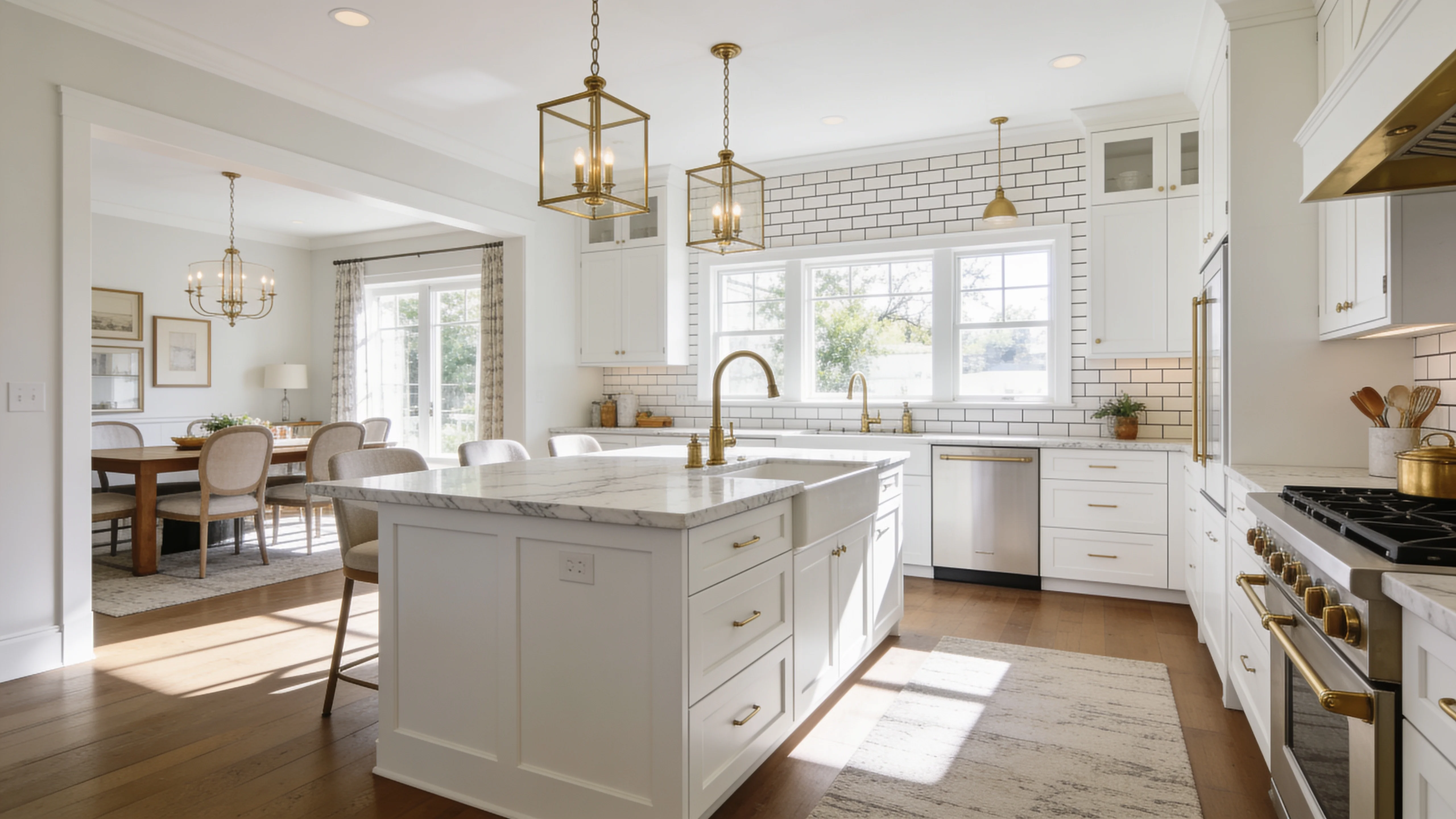
- Classic / transitional. Shaker-style cabinets, the most versatile door profile there is, paired with simple hardware. Neutral palettes with a marble or marble-look counter. It reads timeless and resells well.
- Farmhouse / rustic. Apron-front (farmhouse) sink, open wood shelving, painted cabinets in sage or muted blue, butcher-block or honed-stone counters, brushed or aged brass hardware. Warm and lived-in.
- Scandinavian / Japandi. Pale oak or ash cabinetry, warm-white walls, minimal upper cabinets, honest natural materials. Calm, bright, and forgiving of small footprints. Our Japandi guide covers the palette in depth.
- Industrial. Matte black or dark green cabinets, concrete or soapstone counters, exposed metal shelving, statement pendant lighting. Bold and best in spaces with good ceiling height.
Cabinets, Counters, and Backsplash Pairings
Cabinets are the largest visual surface in a kitchen and typically the biggest line item — often 40 percent or more of a remodel budget — so they anchor every other choice. The counter and backsplash then either support or fight the cabinets. A few reliable pairings that consistently read well:
- White shaker cabinets + white or grey-veined quartz counter + subway tile backsplash. The classic, bright, resale-safe combination. Add warmth with brass or matte-black hardware.
- Warm oak or walnut cabinets + honed white or greige counter + zellige or handmade tile. Organic and current — the wood supplies warmth, the matte stone keeps it calm.
- Deep green or navy lower cabinets + white upper cabinets + marble-look counter + brass fixtures. Two-tone kitchens add depth without overwhelming; keeping the color low grounds the room.
- Matte black slab cabinets + light concrete-look counter + minimal backsplash. Modern and dramatic — best with generous natural light to prevent heaviness.
The rule of thumb: let one element be the star and keep the others supporting. If the counter is a bold veined marble, keep the cabinets and backsplash quiet. If the cabinets are a saturated color, keep the counter and tile neutral. Kitchens go wrong when two or three elements all shout at once.
"A kitchen countertop is a decision you live with for fifteen years. Spending thirty seconds to see it in your actual kitchen first is the cheapest insurance in home improvement."
Small-Kitchen Space Tricks
Small kitchens do not have to feel cramped — they have to be designed to feel open. The techniques that work are consistent across styles.
Go light and continuous. Pale cabinets, a light counter, and a backsplash that reads close to the counter tone all reduce visual breaks, which makes the eye read the space as larger. High contrast chops a small kitchen into pieces.
Reduce upper cabinets. Wall-to-wall upper cabinets press down on a small room. Replacing some with open shelving or a single band of tile opens the walls and makes the ceiling feel higher — at the cost of some hidden storage, so balance to taste.
Reflect and extend. A glossy or glass tile backsplash, a mirror splashback, or under-cabinet lighting bounces light around and erases dark corners. Vertical elements — tall cabinets, vertical tile layout, a pendant hung high — draw the eye up and imply height.
Choose scaled hardware and fixtures. A hulking range hood or oversized pendants overwhelm a small footprint. Slim profiles and integrated appliances keep the room calm. For more on making tight rooms feel generous, our living room design guide covers the same spatial principles applied to seating areas.
Lighting and Hardware Details
The details are where a competent kitchen becomes a memorable one. Lighting should work in three layers: ambient (overhead or recessed for general light), task (under-cabinet strips over the counter and a light over the sink, where you actually work), and accent (pendants over an island or a peninsula, both functional and decorative). Warm-white bulbs around 2700K to 3000K keep food and wood looking appealing; cool white makes a kitchen feel clinical.
Hardware is the jewelry of the kitchen and one of the cheapest ways to shift the whole feel. Brushed brass warms a space and pairs beautifully with white, navy, and wood. Matte black adds modern contrast and grounds lighter palettes. Brushed nickel and stainless read clean and neutral. Swapping dated hardware alone can modernize a kitchen for a few hundred dollars — one of the highest-return micro-projects available to any homeowner.
Budget-Conscious Kitchen Refreshes
Not every kitchen problem requires a full remodel, and some of the highest-impact changes cost a tiny fraction of gutting the room. If your layout works and your cabinet boxes are sound, a cosmetic refresh can transform the space for a few thousand dollars rather than tens of thousands. The proven high-return moves, roughly in order of impact per dollar:
- Paint or reface the cabinets. Solid-wood or MDF cabinet doors take paint beautifully. A professional respray in a warm white, sage, or deep navy delivers most of the visual effect of new cabinetry at a small fraction of the cost.
- Swap the hardware. New pulls and knobs in brass or matte black instantly update the era of the whole kitchen.
- Update the backsplash. A new tile or even a well-chosen peel-and-stick option changes the room's character and is one of the more forgiving DIY jobs.
- Change the lighting. Adding under-cabinet strips and a pair of pendants, and switching to warm-white bulbs, changes how every other surface reads.
- Refresh the fixtures. A modern faucet and a new sink are visible every day and comparatively inexpensive.
Sequence a refresh from the biggest visual lever down, and stop when the kitchen feels right — you may find you never needed the full remodel at all. Seeing the refreshed combination on your actual kitchen first tells you whether cosmetic changes will get you where you want to go, or whether the layout itself is the real problem.
Visualize Your Kitchen Before Remodeling
Here is the move that changes kitchen planning entirely. Instead of assembling samples and trying to imagine how they combine across your entire room, photograph your actual kitchen and see the finished result. Take a clear, straight-on photo in daylight, upload it to Decorb, and generate the combinations you are considering — white shaker with quartz and brass, then warm oak with honed stone, then two-tone navy with marble — all rendered in your real kitchen, with your real windows, your real light, and your real proportions.
This does something no sample board can. It shows you how the finishes behave together in your specific space, at scale, under your lighting. The countertop that looked perfect on a two-inch sample often reads completely differently across eight feet of counter next to your cabinets. Seeing it first is how you avoid the single most expensive category of kitchen regret: finishes that were beautiful in isolation and wrong in the room. See new cabinets, counters, and backsplashes on your actual kitchen before you spend a dollar on the remodel. For the full workflow across every room, read our complete AI interior design guide.
Kitchen Design Mistakes to Avoid
The most common ways kitchens disappoint their owners, and how to sidestep each one:
- Prioritizing looks over layout. A gorgeous kitchen with an awkward work triangle frustrates you three times a day. Solve the flow first, then dress it.
- Too many competing finishes. A bold counter, a bold backsplash, and bold cabinets all at once creates visual chaos. Pick one hero and let the rest support it.
- Underestimating storage. Removing all upper cabinets for a clean look feels great until there is nowhere for the dishes. Balance openness against how much you actually need to store.
- Wrong lighting temperature. Cool-white bulbs make food and wood look flat and clinical. Stay warm — 2700K to 3000K.
- Choosing finishes in showroom light. The single most preventable error. Always evaluate counters and cabinets in your actual kitchen's light, or in a realistic render of it.
- Trend-chasing on permanent surfaces. Put the trend on the hardware and paint, not the ten-thousand-dollar cabinetry. Keep the expensive, permanent choices timeless.
A kitchen you love is not a matter of budget or luck — it is a matter of getting the layout right, choosing a coherent palette, and confirming the result in your actual space before you commit. Once you have seen it, the decisions stop feeling like gambles. Explore how the same approach transforms other rooms in our guides to AI bedroom design and AI living room design.