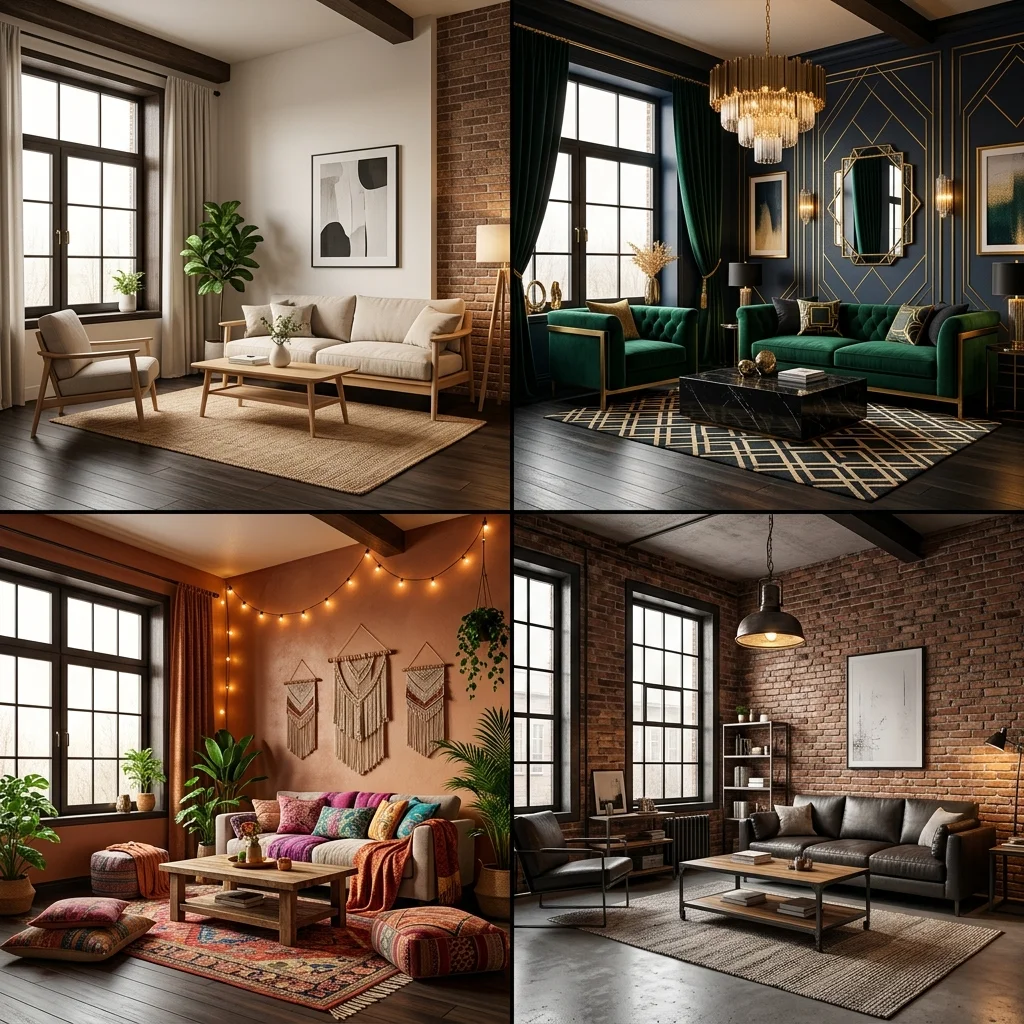
The price gap between hiring an interior designer and using an AI tool is not what most people expect. It's not 2x. It's not even 10x. For the specific job most homeowners actually want done — seeing what their room could look like before spending money — the gap is closer to 100x. This article breaks down what you actually pay for each, what you actually get, and when the premium is genuinely worth it.
I went through this entire pricing landscape personally when I was renovating my own space, which is how Decorb got built. Some of these numbers were surprising. Some were infuriating. All of them are real and current as of 2026.
What Interior Designers Actually Charge in 2026
Interior designer pricing in the United States falls into a few different structures, and which one you encounter depends on the designer and the project. Hourly rates run $100 to $200 per hour on average across major metros, with high-end designers in markets like New York, Los Angeles, and San Francisco charging up to $500 per hour. New designers and those in lower-cost markets sometimes start at $50 an hour, but those are increasingly rare.
The initial consultation alone — before any actual work begins — typically runs $50 to $500. Some designers waive this if you hire them. Many don't.
Per-room flat fees are the most common pricing structure for residential work. Design-only packages (concepts, palette, sourcing list, no project management) run $1,000 to $3,000 per room. Design plus furniture sourcing — where the designer actually orders and oversees delivery — runs $2,000 to $10,000 per room depending on scope and the size of the furniture budget.
Full-home projects average $8,529 according to industry surveys of 2025-2026 pricing, with a range from roughly $2,056 on the low end to $15,216 on the high end. These numbers are before furniture cost. They're for the designer's services only.
The commission model is where things get less transparent. Many designers charge 10% to 40% on top of every piece of furniture you buy through them. They sometimes disclose this. They sometimes don't. The offset is that they have access to to-the-trade pricing — wholesale rates from furniture vendors — which can be 30% to 50% below retail. Whether you come out ahead depends on whether the trade discount is bigger than the commission markup. Often it is. Sometimes it isn't.
The blunt summary: a living room design from a mid-tier designer in any major American city costs $2,500 to $5,000 before you've bought a single piece of furniture. A whole-home engagement runs $8,000 to $15,000 in designer fees, plus furniture, plus contractor coordination for anything structural.
The Hidden Cost of Designer Timelines
The thing most pricing articles miss is that time is itself a cost. The standard designer timeline for a single room is four to eight weeks from kickoff to final concept approval. For a whole home, it's three to six months. Every week of that timeline is a week where you can't move forward on the renovation — you can't buy furniture, you can't hire a painter, you can't book the contractor.
The reason for the timeline isn't bad workflow. It's the structural reality I covered in another piece: designers outsource visualization. The first round of renderings takes one to two weeks because it goes through a third-party rendering studio. Each round of revisions takes another one to two weeks for the same reason. The designer is essentially project-managing a rendering pipeline that exists outside their office.
The cost of a single iteration cycle with a professional designer, accounting for both their hourly time and the outsourced render fees, is roughly $2,000 to $4,000 and one to two weeks of calendar time. If you need four iteration cycles to land on the right direction — which is normal for a complex room — you've spent $8,000 to $16,000 and four to eight weeks just on the visualization phase. Before any furniture is purchased.
What AI Design Tools Cost
The AI side of this comparison is dramatically simpler.
Decorb has three tiers. The free tier gives you up to 4 credits (1 at sign-up, 3 more earned in the app), no credit card required, no expiration pressure — enough to try the tool on one or two rooms before committing to anything. The Personal tier is $15 per month for 35 credits — roughly $0.43 per generated image. The Pro tier is $49 per month for 150 credits — $0.33 per image at the higher volume.
Other AI tools occupy adjacent price points. Midjourney runs $10 to $60 per month but produces generic interior images, not redesigns of your specific room. Havenly, which pairs AI tools with a human designer, costs $99 to $499 per room — a middle path between pure AI and traditional design. RoomGPT offers a limited free tier and paid plans starting around $9 one-time.
At the $15 Personal tier on Decorb, the math works out as follows. Exploring 10 different style directions for a living room costs roughly $4.30 in credits and takes about an hour. Exploring 10 different style directions with a traditional designer would cost $10,000 to $20,000 in designer time and outsourced renderings, and would take four to eight weeks.
That's not a typo. That's the gap. For visualization specifically — which is the deliverable most homeowners actually want — the cost difference is roughly three orders of magnitude.
"Exploring 10 style directions for your living room costs about $4 with AI. With a traditional designer, the same exploration costs $10,000 to $20,000 and takes two months. That gap is not marketing. It's the real number."
Side-by-Side Cost Comparison
The comparison below uses 2026 averages for each line item.
| Task | Interior Designer | AI Tool (Decorb) |
|---|---|---|
| Initial consultation | $250-$500 | Free |
| First visualization | $1,500-$3,000 (outsourced render) | ~$0.43 per image |
| One revision round | $500-$2,000 | ~$0.43 per image |
| Per-room design package | $1,000-$10,000 | $15/month flat |
| Full-home direction | $5,000-$15,000+ | $15-$49/month |
| Timeline | 4-12 weeks | Minutes |
When the Designer Premium Is Worth It
The honest answer is: often. The premium is real, but it's also paying for real things — when those things are what you actually need.
Structural decisions are the cleanest case. If you're moving walls, opening up load-bearing partitions, rerouting HVAC or plumbing, or anything that requires permits, you need a designer or an architect. AI cannot help here. The fee is justified because the alternative is structural damage or code violations.
Contractor coordination is the second. If your project involves five or six subcontractors over six months, a designer who project-manages the build is worth their hourly rate just in avoided friction. The cost of a poorly managed renovation — schedule slippage, change orders, contractor disputes — easily exceeds the designer's fee.
Trade access and vendor relationships matter at higher budgets. If you're spending $50,000 on furniture, the designer's 30% to 50% trade discount can offset their commission markup and then some. At that scale the math often works out in your favor even with the designer's fees included.
Finally, if you genuinely don't have a design instinct and need someone to fully drive the project, a designer is irreplaceable. AI is most powerful when you know roughly what you like and want to explore variations. If you don't have that baseline, a designer can develop it with you through conversation.
When AI Is Clearly the Right Choice
The other side is just as clean. There are cases where the AI tool isn't just cheaper — it's actually the better tool for the job.
You're deciding whether to buy a specific piece of furniture. Drop a photo of the sofa into a photo of your room. See it. Decide. The cost is forty cents and a minute.
You want to see five color palettes before committing to paint. AI does this in an afternoon for the cost of a single credit per palette. A designer would charge you for a consultation, then a color study, then a sample review — easily $500 to $1,500 and two weeks.
You're renting and can't make permanent changes. There's no structural work, no contractor coordination, no permits. The entire scope is decor and furniture. AI covers this end to end. A designer is overkill.
You want to explore styles before committing to a direction. This is the exploration phase that's most expensive with a designer because each iteration is slow and outsourced. AI's instant iteration is most valuable here.
Your renovation budget is under $20,000. The math gets hard to justify on smaller projects. If the designer's fees are $5,000 and your total budget is $15,000, the designer is consuming a third of your project budget on services alone.
You want to show a partner or family member what you're envisioning before making a decision together. Images are a better shared reference than words. AI gives you the images cheaply.
The Hybrid That Saves the Most Money
The most cost-effective approach combines both. Use Decorb at $15 a month to lock the visual direction across your project — the part that traditionally takes a designer four to eight weeks. Then bring in a designer for execution with a clear visual brief in hand.
The designer's job shrinks dramatically. Instead of charging you for the exploration phase, they charge you for the implementation phase. Fewer hours billed. Faster project. Less back-and-forth on what you actually want, because you walk in with three reference images showing exactly that.
I've watched several friends do this. The numbers are consistent: they save roughly 30% to 50% on total designer fees, and the project moves twice as fast, because the designer doesn't have to spend weeks trying to translate vague descriptions into renderings. The smart designers I know prefer working this way. The ones who resist it tend to be the ones whose business model depends on the slow exploration phase.
Frequently Asked Questions
Is $15 a month enough for a full room redesign?
Yes, easily. The Personal tier gives you 35 credits per month. Most homeowners use 5 to 10 credits per room across the exploration phase. That's enough credits for three to seven rooms in a single month.
Do I get a refund if I don't use all my credits?
No — it's a monthly subscription. The right way to use it is to run your renovation through it during the active design phase, then cancel or pause once you've locked direction. Most projects use Decorb intensively for one to two months total.
Why do designers charge so much for visualization?
Because they outsource it. The rendering studio takes the design brief and produces the images at $1,500 to $3,000 per render. The designer manages the project and adds their hourly time on top. You're paying for both — the renderer's work and the designer's coordination of the renderer. AI tools collapse both of these costs into a single low-friction price.
Is there a middle ground between pure AI and traditional design?
Yes. Services like Havenly pair AI tools with a human designer for a hybrid offering at $99 to $499 per room. It costs more than pure AI but much less than traditional design. Worth considering if you want some human input on the design choices without the timeline and cost of a full traditional engagement.
What's the cheapest way to get a professional-quality result?
Use Decorb at the free tier or $15 Personal tier to nail your visual direction. Print or save the resulting images. Take them to a furniture store or hire a designer for a single consultation hour ($150 to $250) to validate your sourcing list. Total spend: under $300. Total time: a couple of weekends. This is the workflow that consistently produces the best ratio of result quality to dollar spent.
The Bottom Line
For visualization and direction-setting — the part of interior design that most homeowners actually want — AI tools cost 1% to 5% of what a traditional designer charges, and finish the work in minutes instead of weeks. For structural work, contractor coordination, and complex sourcing, traditional designers are still genuinely worth their fees.
The smartest budget you can build for a renovation isn't "designer or AI." It's "AI for the parts AI is great at, designer for the parts that need a human professional." That combination saves money, produces better results, and finishes faster than either approach alone.