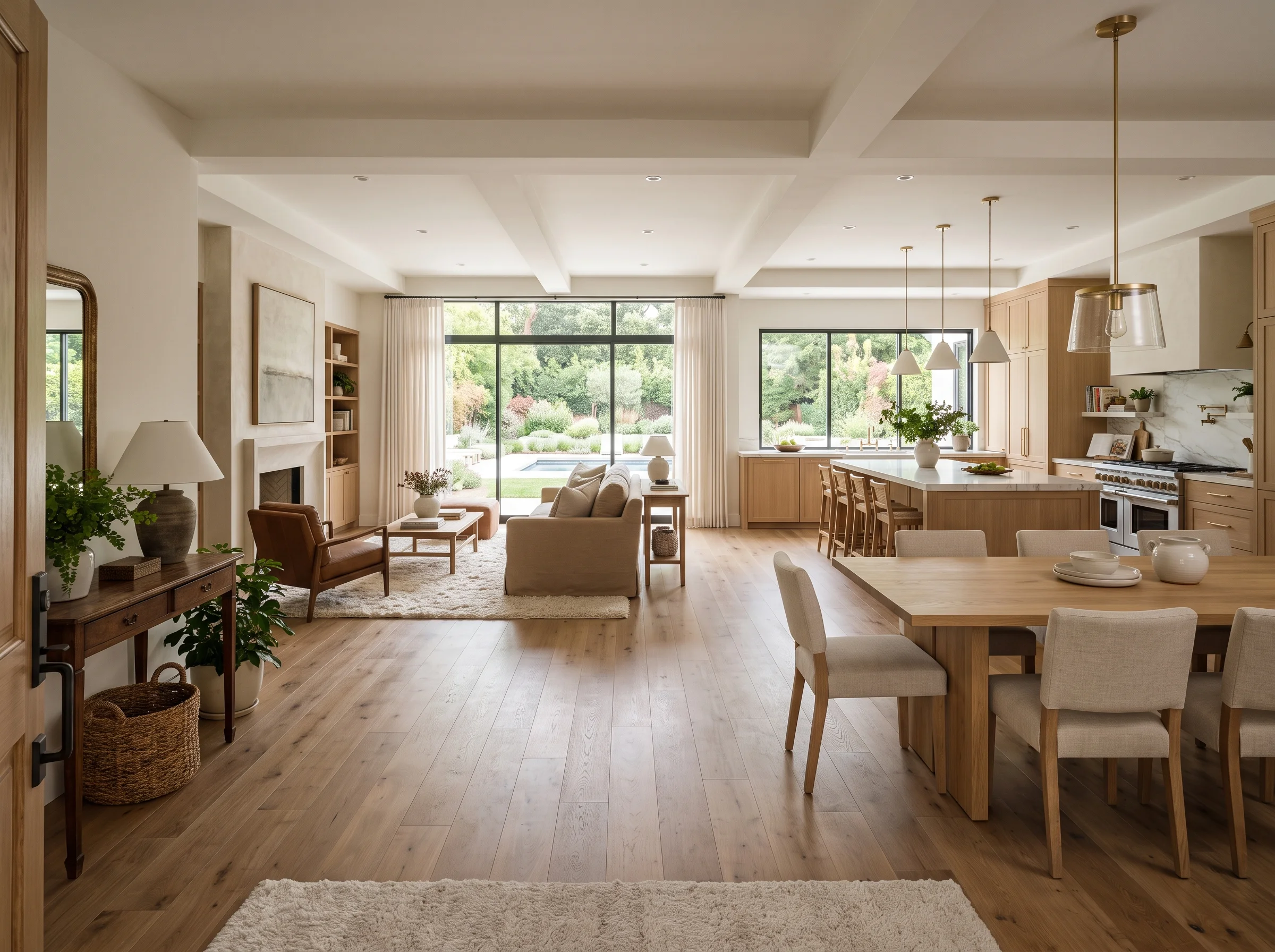
We build an AI interior design tool, so you might expect this article to tell you AI does everything. It doesn't, and we'd rather be honest about that than sell you something that leaves you stuck halfway through a project. AI is genuinely extraordinary at some parts of design and completely absent from others. Knowing which is which is the difference between a smooth renovation and an expensive dead end.
Here's the clean version: AI handles the visual decision-making — the exploration, the seeing, the choosing — better and faster than any human alive. What it can't do is anything that requires hands, a physical presence in your room, or accountability for the outcome. Let's walk through exactly what's missing, because those gaps are real and they matter.
1. AI Has No Physical Presence
An AI model has never touched a fabric swatch. It can show you a linen sofa in your living room in photorealistic detail, but it cannot tell you whether that linen will pill after a year of a golden retriever sleeping on it. It can render a matte quartz countertop beautifully, but it can't run a fingernail across the surface to feel whether it will scratch under a dropped pan.
This tactile knowledge is a huge part of what experienced designers sell. They've handled thousands of materials over years of work. They know which velvets crush, which paints read chalky in real light, which wood finishes dent under chair legs. No image-generation model has hands, and until it does, the durability and feel of materials is a gap you fill either by ordering samples yourself or by leaning on someone who has handled them.
2. AI Has No Structural Knowledge
AI sees the surface of your room — the pixels in the photo you uploaded. It cannot see behind your drywall. It doesn't know whether the wall you want to remove is load-bearing, where your plumbing runs, or whether your electrical panel can take another circuit. Ask it to "open up this wall" and it will happily render the result. It has no idea whether that's a weekend job or a structural engineer situation.
This is the single most consequential gap. Visual decisions are reversible and cheap. Structural decisions are neither. Anything involving walls, wiring, plumbing, or the bones of your home requires a human professional who can stand in the space and read what's actually there.
3. AI Can't Coordinate Contractors
A real renovation is a logistics problem as much as a design problem. Somebody has to sequence the trades — demo before electrical, electrical before drywall, drywall before paint, paint before flooring, flooring before the finish carpentry. Somebody has to hold each of those people to a schedule, catch mistakes before they get buried, and mediate when the tile guy and the plumber disagree.
AI does none of this. It has no phone, no relationships, no ability to show up on site and notice that the outlets got installed at the wrong height. On a multi-trade project, this coordination is often the most valuable thing a designer or general contractor provides, and it's entirely outside what any AI tool can touch.
"AI covers the roughly 60% of design that's visual decision-making. The other 40% — execution, sourcing, construction — still needs human hands and human accountability."
4. AI Has No To-the-Trade Sourcing
Experienced designers have vendor relationships that took years to build. They can access trade-only product lines you'll never find on a consumer website, get samples shipped for free, and negotiate pricing that offsets part of their fee. When they specify a specific sofa, they can often actually get it — at a better price, with a real lead time, through a rep they know by name.
AI can show you a sofa that looks perfect. It can't tell you the manufacturer, whether it's in stock, or how to buy it. Closing that gap between "I love this look" and "here is the actual product in my cart" is real work, and right now a human does it better.
5. AI Has No Legal Accountability
When you hire a professional, part of what you're buying is recourse. If the design fails — if the custom cabinets don't fit, if the specified flooring voids a warranty — there's a person and a contract behind the decision. There's someone to hold responsible.
AI offers no accountability. It's a tool, and the decisions you make with it are yours. For low-stakes visual choices, that's completely fine. For a six-figure renovation, the presence of a responsible professional is worth paying for.
What AI Is Genuinely Exceptional At
Now the other side, because the gaps above don't cover most of what a typical homeowner project actually involves. For everything visual, AI isn't just adequate — it's better than the traditional alternative.
Photorealistic visualization of your actual room is the headline. Upload a photo, and in seconds you see your space transformed — not a generic stock room, your room. Style exploration across many aesthetics is nearly free: try Japandi, warm minimalist, mid-century, and coastal on the same room in the time it takes to make coffee. Color and furniture testing before you spend a dollar means you never again buy a sofa hoping it works. And showing a partner or family what you're picturing turns a frustrating verbal argument into a shared image everyone can point at.
These are exactly the tasks that used to be slow, expensive, and outsourced. AI collapses them from weeks to seconds.
The Hybrid Approach That Covers Everything
The honest conclusion isn't "use AI" or "hire a human." It's that these two things cover different halves of the same project, and the smartest homeowners use both in sequence.
Think of a room project as roughly 60% visual decision-making and 40% physical expertise. The visual 60% — exploring directions, visualizing your space, choosing colors and furniture, aligning everyone on a look — is where AI dominates. Do that part yourself, in an afternoon, at almost no cost. You'll arrive at a clear, specific direction backed by real images of your own room.
The physical 40% — execution, sourcing, construction, coordination — is where humans still earn their fee. If your project stays entirely in visual territory (paint, furniture, decor, layout), you may never need the human half at all. If it crosses into walls, wiring, plumbing, or multi-trade construction, that's exactly when you bring in a professional — and you bring them a finished visual brief instead of a vague description, which makes their job faster and your bill smaller.
That's what's missing when you design with AI alone: not taste, not visualization, but hands, structural sight, and accountability. Match the tool to the task, and the gaps stop being a problem.