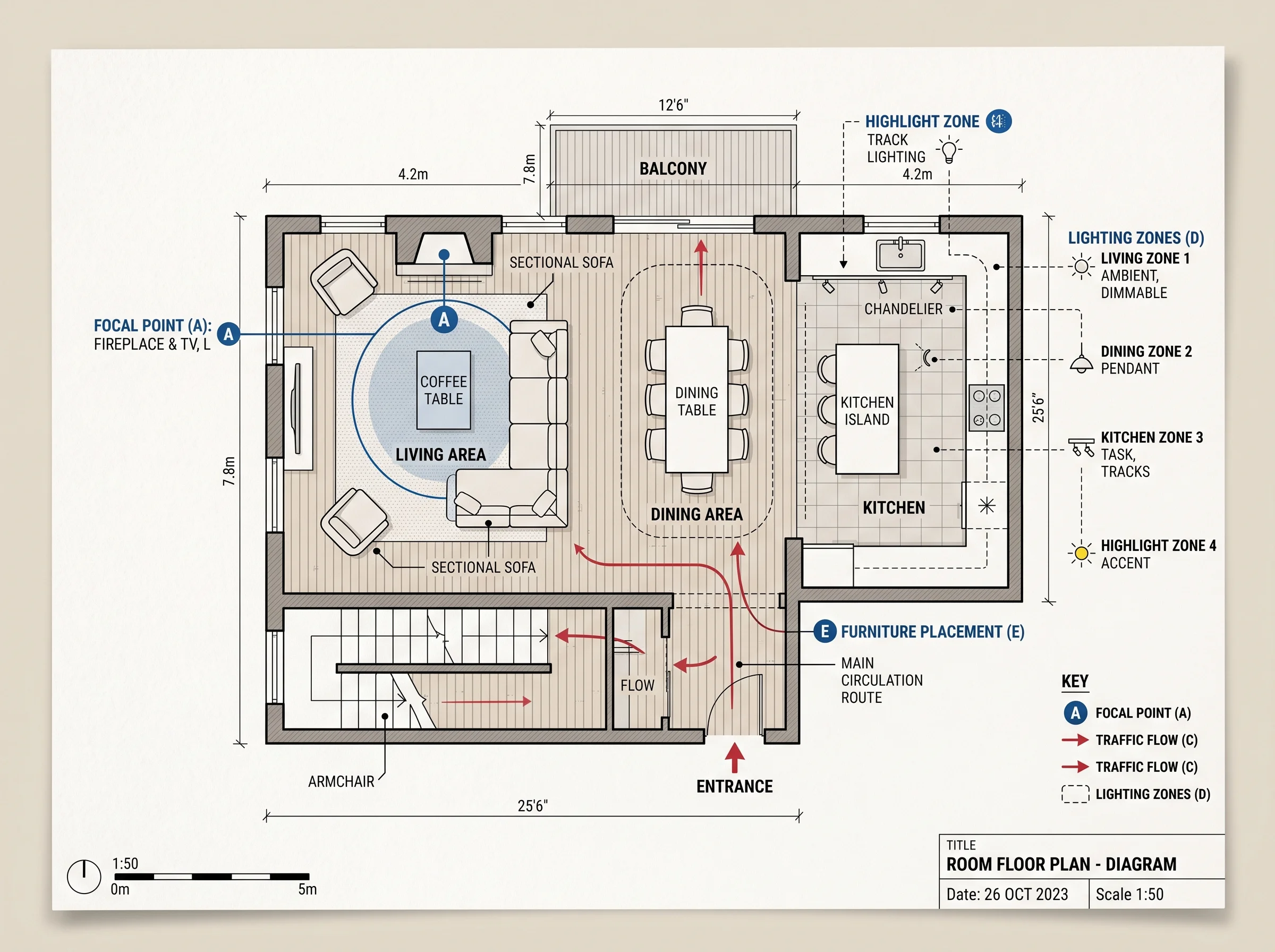
When a designer walks into a room for the first time, they don't see furniture. They see a set of constraints and opportunities that most people never consciously notice. Before a single sofa gets placed or a paint chip gets held to the wall, an experienced designer has already run the space through a mental checklist — a dozen or so factors that quietly determine whether the finished room will feel right.
This is the difference between a room that "just works" and one that feels subtly off in ways you can't name. The good news: the checklist isn't secret, and you can run it yourself. Here are the twelve factors designers evaluate before they plan anything.
1. Primary Function and Secondary Uses
The first question is always: what is this room actually for? Not the label on the floor plan — the real use. A "living room" might be a media room, a playroom, a home office, and an occasional guest room all at once. Designers identify the primary function first, then the secondary uses, because a room that serves four purposes needs to be planned differently from one that serves one. Everything downstream depends on getting this right.
2. Who Uses the Room and How
Next: who lives with this space, and how do they move through it? A household with young kids, a couple who work from home, an older person who values easy circulation — each implies different materials, layouts, and priorities. Designers plan around the actual humans, not an abstract ideal occupant.
3. Natural Light
Light is one of the most powerful and most overlooked factors. Designers note the direction the windows face, because it changes everything. South-facing rooms get warm, abundant light most of the day and can handle cooler, deeper colors. North-facing rooms get flat, cool, consistent light and often need warmer palettes to compensate. East and west light shifts dramatically morning to evening. They also track intensity and time of day, because a room used mainly in the evening is planned differently from one lived in at noon.
4. Traffic Flow
A room has to be walked through, not just looked at. Designers map the entry and exit points and the paths people naturally take between them, then arrange furniture so those paths stay clear. The working rule of thumb is a minimum of about 36 inches of clearance for main walkways — enough to move comfortably without turning sideways. A beautiful layout that blocks the natural path through the room will always feel wrong.
"Designers don't start with the sofa. They start with the light, the doors, and the way a body moves through the space. The furniture comes last."
5. Focal Point
Where does the eye land when you walk in? Every well-designed room has a clear focal point — a fireplace, a window with a view, a bed, a piece of art, a statement light. Designers identify or create it early, because the entire arrangement orients around it. A room without a focal point feels aimless; a room with two competing focal points feels chaotic.
6. Existing Fixed Elements
Some things aren't moving: windows, doors, radiators, vents, structural columns, and the location of the fireplace. Designers inventory these fixed constraints first and plan around them rather than fighting them. A radiator under the best window or a vent in an awkward spot shapes what's possible, and pretending otherwise leads to plans that can't actually be executed.
7. Scale and Proportion
This is where amateur rooms most often go wrong. Designers evaluate furniture in relation to the room and in relation to each other. A sofa that's too big overwhelms a small room; pieces that are too small look lost in a large one. Coffee tables should relate proportionally to sofas, side tables to chairs, art to wall size. Getting scale right is often the invisible reason a professionally designed room simply feels correct.
8. Storage Needs
Designers assess how much storage the room requires and decide what should be visible versus hidden. A room that can't absorb the stuff of daily life will always drift toward clutter, no matter how beautiful the starting point. Planning storage up front — closed cabinets for the things you want out of sight, open shelving for the things worth displaying — keeps the finished room livable rather than just photogenic.
9. Acoustic Considerations
Sound is part of how a room feels, even though we rarely think about it. Hard surfaces — bare floors, glass, plaster — create echo and make a space feel harsh. Soft surfaces — rugs, upholstery, curtains, textiles — absorb sound and make a room feel calm and comfortable. Designers balance hard and soft so the room sounds as good as it looks, which matters enormously in open-plan and high-ceilinged spaces.
10. Electrical Outlet Placement
A deeply practical constraint: where are the outlets? Outlet placement limits where lamps, TVs, and devices can go, which in turn limits furniture arrangement. Designers note existing electrical locations early, because discovering that your ideal sofa placement leaves no way to plug in a floor lamp — after everything is bought — is a frustrating and common mistake.
11. Budget Constraints
Good designers separate what can change from what's fixed, and plan the budget accordingly. Repainting is cheap; moving a wall is not. Slipcovering is affordable; custom millwork is not. Understanding which levers are inexpensive and which are costly lets them concentrate spending where it delivers the most visible impact, rather than blowing the budget on something that barely moves the needle.
12. Cohesion with Adjacent Spaces
Finally, a room is never truly isolated. Designers consider what's visible from the doorway and how the room relates to the spaces around it — especially in open-plan homes. Colors, materials, and styles should have a relationship with adjacent rooms so the home reads as a whole rather than a series of disconnected boxes. A gorgeous room that clashes with everything you can see from its entrance undermines itself.
How to Apply the Checklist Yourself
You don't need a degree to run this list. Walk into your room and go through the twelve factors one at a time. What's the real function? Who uses it and how? Which way do the windows face and when is the room used? Where do people walk? What's the focal point? What's fixed? Is the furniture the right scale? Where does storage need to go? Is it too echoey? Where are the outlets? What's cheap to change versus expensive? What do you see from the doorway?
Answering honestly gives you the same structured understanding a designer builds — and it usually surfaces the reason a room hasn't been working. Maybe the focal point is unclear. Maybe the sofa fights the traffic path. Maybe the light called for warmer colors all along.
Once you know what needs to change, the last step is seeing whether your fix actually delivers. This is where AI visualization earns its place: you can test the reworked layout, the warmer palette, or the new focal point on a photo of your real room before committing money to any of it. Run the checklist to find the problem, then see the solution rendered on your own four walls.
The Takeaway
What separates a designed room from a decorated one isn't taste — it's this checklist, applied before anything is chosen. Function, users, light, traffic, focal point, fixed elements, scale, storage, acoustics, outlets, budget, and cohesion. Each factor quietly shapes whether the finished space feels effortless or subtly wrong.
Run the list on your own room. It'll tell you what's holding the space back. Then test the solution visually before you spend, and you'll be making the same informed decisions a professional would — with your eyes open the whole way through.