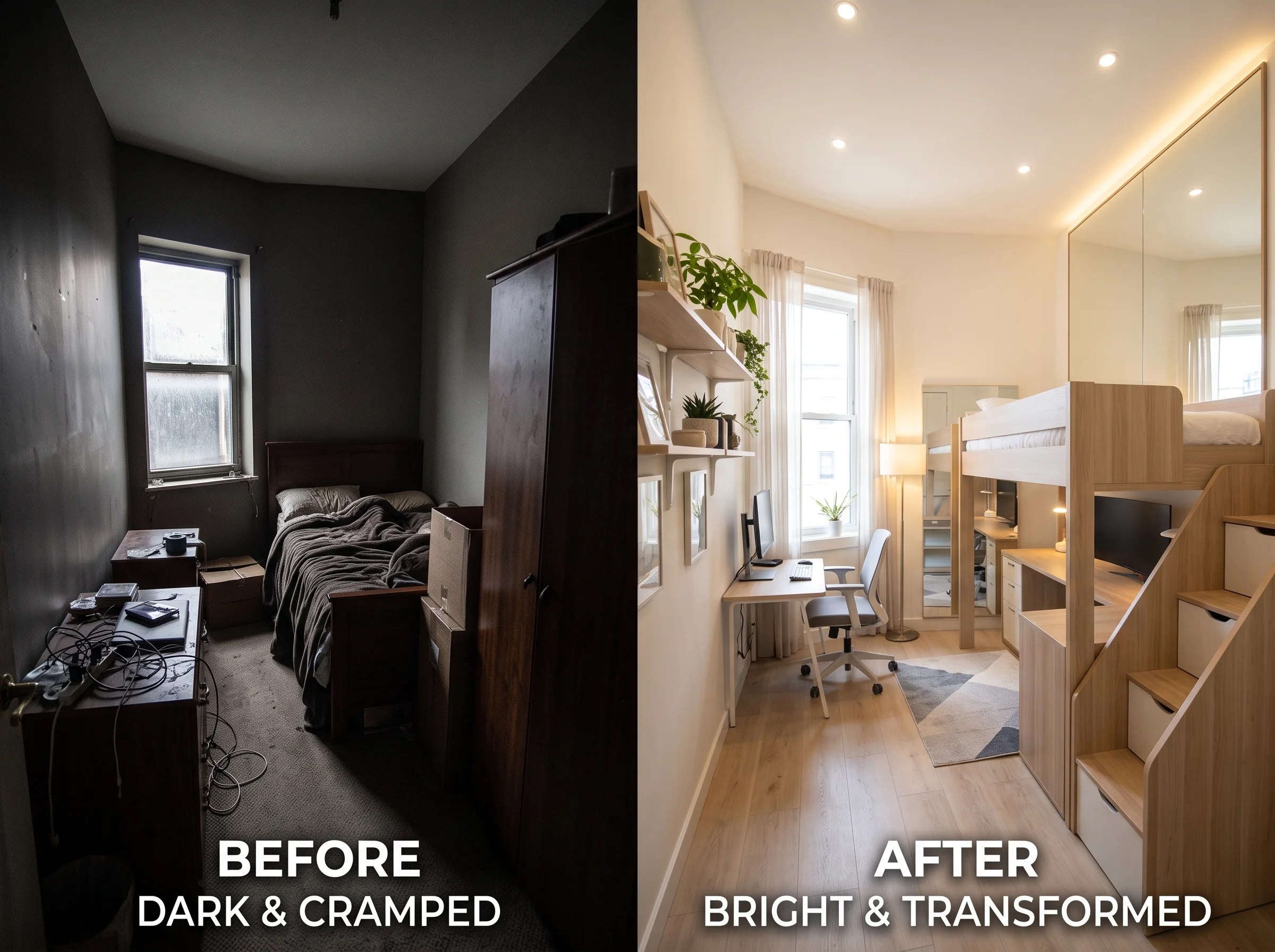
Most decorating problems feel unique when you're standing in the middle of your own living room, frustrated. But professional designers have seen every one of them a hundred times. The room that feels cramped, the lighting that makes everything look gray, the furniture that refuses to get along — these aren't personal failures. They're common, well-understood problems with well-understood solutions.
The difference between a designer and a frustrated homeowner isn't taste. It's a mental library of fixes and the confidence to apply them. This article hands you that library. Seven of the most common decorating problems, the exact solutions designers reach for, and how you can test each fix on your own room before spending a dollar.
Problem 1: The Room Feels Too Small
A small room is rarely as small as it feels. Most of the time, the space is being visually compressed by choices that can be reversed. Designers attack this on several fronts at once.
Mirrors are the classic move because they work. A large mirror placed to reflect light and depth effectively doubles the perceived area of a wall. Light colors on walls and ceilings recede, which pushes the boundaries of the room outward, while dark colors advance and close in. Vertical lines — tall bookcases, floor-to-ceiling curtains hung high, striped elements — draw the eye up and make ceilings feel taller. Multifunctional furniture, like a storage ottoman or a bed frame with drawers, reduces the number of individual pieces cluttering the floor. And decluttering itself is the most underrated fix: every object removed gives the eye somewhere to rest, and rest reads as space.
The point is that none of these require knocking down a wall. They each visually expand the room, and stacked together, they transform it. Before you commit to a paint color or a mirror size, you can drop the change onto a photo of your actual room and see whether the space opens up the way you hoped.
Problem 2: The Room Feels Cold and Uninviting
Some rooms are technically well-decorated but leave you cold. Usually the issue is temperature — both literal and visual. The single biggest lever is lighting color. A 5000K "daylight" bulb throws a clinical, bluish light that flatters a hospital corridor and almost nothing else. Swapping to warm 2700K bulbs instantly makes a space feel like somewhere you'd want to spend an evening.
From there, designers layer in warmth through material. Textiles do the heavy lifting: a chunky throw, a wool rug, linen curtains, a few textured cushions. Organic shapes — a round table, a curved chair, an arched mirror — soften a room full of hard right angles. And warm wood tones, whether in flooring, a side table, or open shelving, add the kind of natural warmth that no amount of gray paint can replace.
A cold room is almost always an under-layered room. The fix is addition, not subtraction, and it's easy to preview which textiles and wood tones will warm your specific space.
Problem 3: Awkward Proportions
Long, narrow rooms and oddly shaped spaces defeat a lot of homeowners. The instinct is to push all the furniture against the walls, which only emphasizes the awkwardness. Designers do the opposite: they use an area rug to anchor a defined zone, then float furniture around it.
In a long room, this means creating two or more groupings — a conversation area at one end, a reading or dining zone at the other — each anchored by its own rug. The zones break the bowling-alley effect and give the room a sense of intentional structure. The rug is the tool that tells the eye, "this is a room within the room."
Problem 4: No Natural Light
North-facing rooms, basement apartments, and spaces with small windows all suffer the same way: not enough daylight to feel alive. You can't add a window easily, but you can work with what light exists and supplement the rest.
Mirror placement is the first move — position a mirror directly opposite whatever window you have to bounce that daylight deeper into the room. Then build layers of warm-toned artificial light rather than relying on a single overhead fixture. A table lamp, a floor lamp, and a warm bulb in the ceiling fixture create pools of light at different heights, which reads as far more inviting than one flat wash from above. Light-reflecting surfaces — glossy finishes, a pale rug, metallic accents — help whatever light you have travel further.
"A dark room is rarely a lost cause. It's usually a lighting-layering problem wearing the costume of an architecture problem."
Problem 5: Furniture That Doesn't Go Together
You've accumulated pieces over years — an inherited armchair, a couch bought in a hurry, a table from a different apartment. Individually they're fine. Together they fight. Designers unify mismatched furniture with two tools.
The first is the 60-30-10 color rule: 60 percent of the room in a dominant color (usually walls and large furniture), 30 percent in a secondary color, and 10 percent in an accent. When your pieces share this proportional palette, they read as a set even when they aren't. The second tool is identifying one unifying element — a repeated wood tone, a shared metal finish, a color that appears in a cushion here and a lampshade there — and deliberately echoing it across the room. Repetition is what your eye interprets as intention.
Problem 6: Too Much or Too Little Furniture
Both extremes make a room feel wrong. Over-furnished spaces feel cramped and cluttered; under-furnished spaces feel cold and unfinished. Designers rely on scale rules to find the balance.
A sofa, for example, should generally occupy no more than about two-thirds of the wall it sits against — enough to feel substantial, not so much that it dominates. An area rug should be large enough to sit under at least the front legs of all the surrounding furniture, which visually ties the grouping together and makes the whole arrangement feel deliberate rather than scattered. When a room feels empty, the fix often isn't more furniture — it's a properly sized rug and one or two anchoring pieces at the right scale.
Problem 7: No Focal Point
A room without a focal point feels aimless. Your eye enters and has nowhere to land. Some rooms come with a built-in focal point — a fireplace, a great window, a view. Many don't, and in those rooms the designer's job is to create one.
That might be a large piece of art on the main wall, a bold light fixture over a table, an accent wall in a saturated color, or a single statement piece of furniture. The rule is one focal point per room — competing focal points cancel each other out and return you to the aimless feeling. Choose the wall your eye hits first when you walk in, and make that the star.
Why Testing Beats Guessing
Here's the honest catch with all seven of these solutions: they're principles, not guarantees. A lighter wall color usually opens a small room, but the specific shade matters, and the only way to know for sure is to see it in your space. A mirror opposite your window will bounce light, but the size and placement change everything. This is exactly where professional designers historically added value — they'd seen enough rooms to predict the result.
You can now short-circuit that experience. Upload a photo of the room that's frustrating you, apply the fix you're considering, and see the result before you commit. Try the warmer palette. Move the focal point. Add the rug. The decorating problems in this article are common precisely because they're solvable, and the fastest path to solving yours is to test the fix on your own four walls instead of guessing.
Start with the problem that bothers you most. Apply the matching solution. See it rendered on your room. Then decide with your eyes instead of your imagination — that's the whole trick designers have used all along.