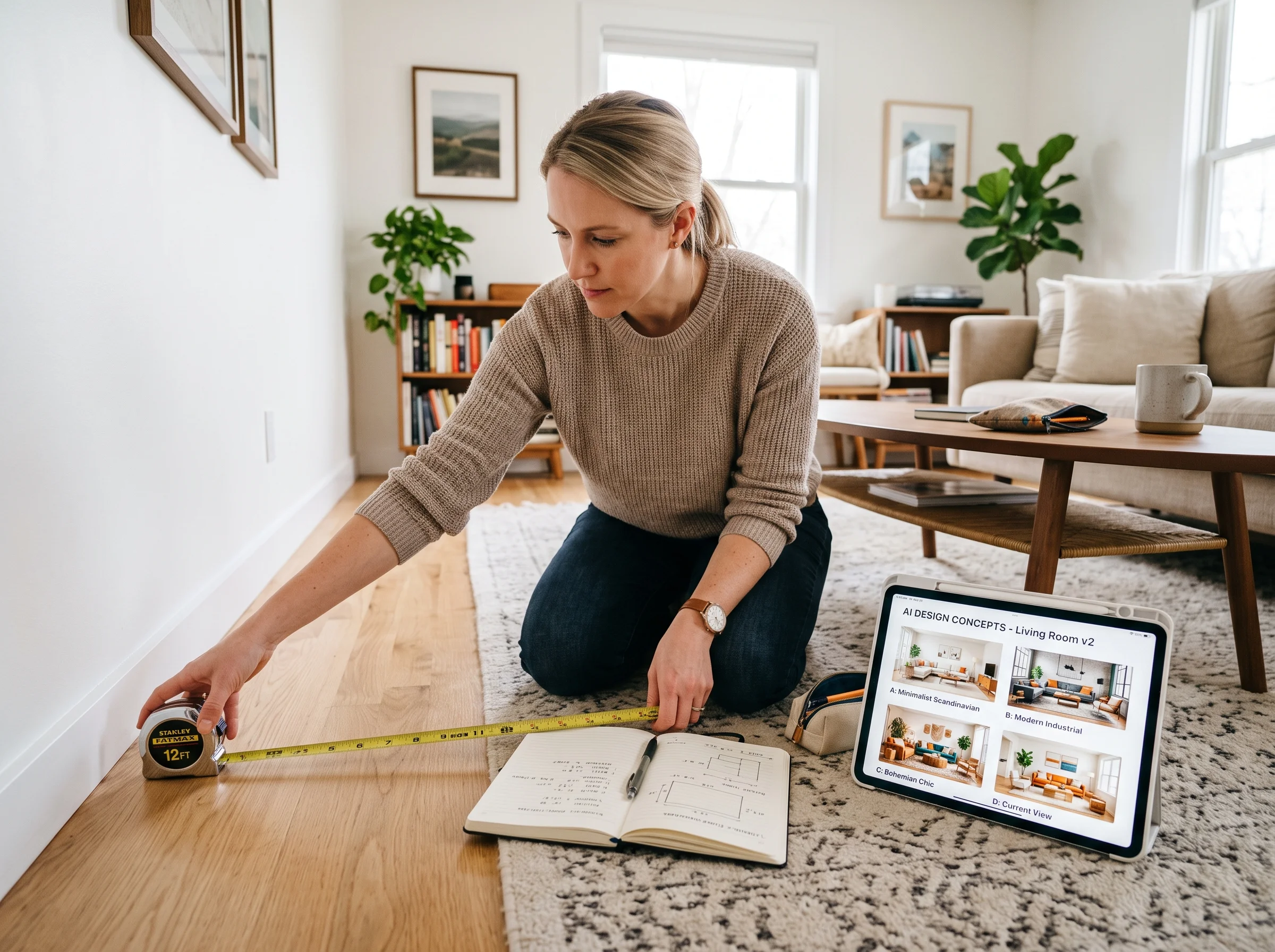
Interior designers bill for their time, and the first phase of almost every project is discovery — the slow, expensive process of figuring out what you have, what you want, and what your constraints are. Here's the thing most homeowners don't realize: much of that discovery is work you can do yourself, before the meter starts running. The better prepared you arrive, the less you pay for someone to extract basic information from you one question at a time.
Preparation isn't just about saving money, though it does that. It's about getting a better result, because a designer working from clear inputs makes sharper decisions than one working from vague gestures. Here's the exact checklist to walk in with.
1. Accurate Measurements
Nothing slows a project like missing dimensions. Before the meeting, produce a simple floor plan with the room's dimensions marked. You don't need drafting skills — your phone's built-in measurement app or a $10 laser measure will do. Capture the overall length and width, the ceiling height, and the size and position of windows and doors. A designer who has your real numbers on day one can start planning immediately instead of scheduling a separate site-measure visit you'll pay for.
2. Inventory of What Stays
Decide what you're keeping, and document it. Photograph every piece that's staying — the sofa, the dining table, the rug, that inherited armchair — and note its dimensions. This tells the designer what they're building around. Nothing is more wasteful than a designer developing a plan, then discovering three meetings in that you have no intention of parting with the bookcase your grandfather made. Get the keepers on the table from the start.
3. A Pain Points List
Write down every frustration you have with the current space. The corner that collects clutter. The lighting that's never right for reading. The traffic jam by the kitchen doorway. The lack of anywhere to put your bag when you walk in. These pain points are the most valuable brief you can give a designer, because they define the problems the design actually needs to solve — not the aspirational version, but the real, daily friction.
4. A Real Budget Number
This is where homeowners most often hold back, and it costs them. Designers cannot work with "reasonable" or "not too much." They need a specific number. A real budget lets a designer allocate intelligently — where to splurge, where to save, what's even possible. Vague ranges force them to guess, and guessing wrong wastes everyone's time. Decide on a number you're genuinely comfortable with and state it plainly. It's not a ceiling they'll rush to hit; it's the constraint that makes good planning possible.
"A designer can't design against 'something reasonable.' Give them a real number and a clear list of what's broken, and the first meeting does the work of the first three."
5. Timeline
Do you have hard deadlines? Guests arriving for the holidays, a baby on the way, a lease ending, an event you're hosting? Tell the designer up front. Timelines shape everything from what materials are feasible (custom pieces have long lead times) to how the project is sequenced. A designer who knows you need the room done in eight weeks makes very different choices than one who assumes you have six months.
6. Reference Images
Gather 10 to 15 images of rooms you love. A Pinterest board is perfect. These give the designer a read on your taste that no verbal description can match — "warm and modern" means a hundred different things, but a handful of saved rooms shows exactly what it means to you. Include the reasons where you can ("I love the light in this one," "this feels cozy without being cluttered") so the designer understands what's drawing you, not just what you saved.
7. Lifestyle Information
Come ready to describe how you actually live in the space. Who's in the household — partners, kids, pets, visiting family? What are your routines in the room? Do you entertain? Work from home? Have a dog that sheds on everything? This context shapes materials, durability, and layout in ways that pure aesthetics can't. A designer planning for a family with a large dog and two toddlers makes fundamentally different material choices than one planning for a minimalist couple.
The Game-Changer: Arrive With AI Concepts
Here's the step that changes the entire dynamic of the first meeting. Before you sit down with a designer, generate AI concepts of your actual room in three to five style directions. Upload a photo of your space and produce a warm-modern version, a Scandinavian version, a bold-and-saturated version — whatever directions intrigue you. It takes an afternoon and costs almost nothing.
Then walk into the meeting and show those images instead of describing your preferences. This is a profound shift. Normally the designer spends the first weeks of the engagement translating your vague words into visual concepts, showing them to you, and refining based on your reactions — the slow, billable discovery loop. When you arrive with visuals already in hand, the designer can respond to them immediately. "I like this one but warmer." "This direction, but I hate that specific sofa." "Somewhere between these two." The conversation starts at a level of specificity that normally takes weeks to reach.
The effect is that discovery collapses from weeks of back-and-forth into one focused conversation. You're not paying the designer to guess at your taste; you're pointing at exactly what you want and letting them do what they do best — refine, source, and execute. Designers, for their part, tend to love clients who show up this way, because a clear visual brief makes their job dramatically easier and the result dramatically better.
Putting It All Together
Show up to your first designer meeting with seven things: accurate measurements, an inventory of what stays, a pain-points list, a real budget number, your timeline, a set of reference images, and honest lifestyle context. Then add the eighth — AI concepts of your own room in a few directions — and you've transformed the meeting from open-ended discovery into focused execution planning.
Preparation like this respects both your budget and the designer's expertise. You stop paying for someone to pull basic facts out of you, and the designer gets to spend their billable hours on the high-value work: turning a clear brief into a room you'll love. Come prepared, and the whole engagement gets faster, cheaper, and better.