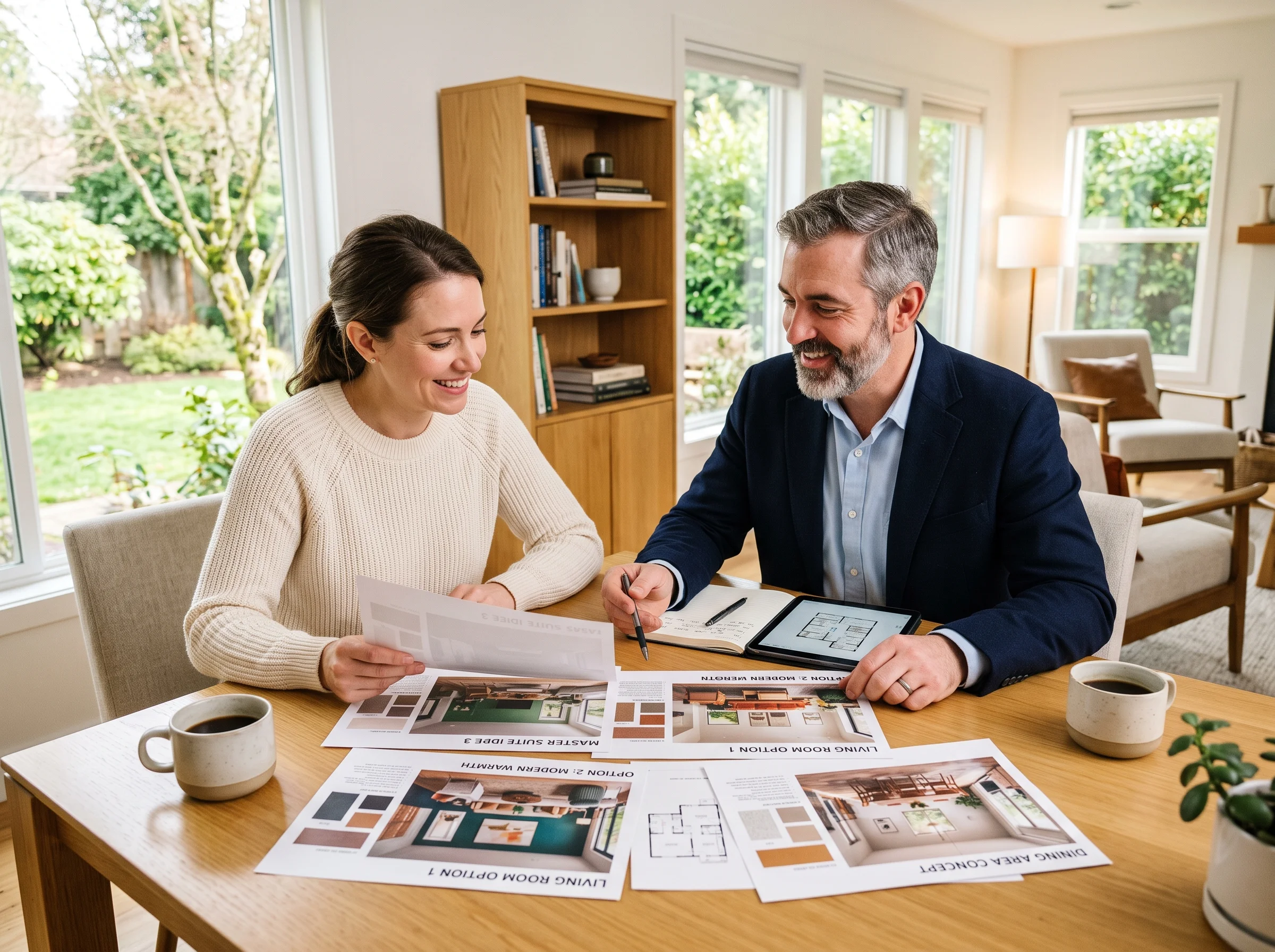
The first consultation with an interior designer is a two-way interview disguised as a friendly chat. You're deciding whether this is the person to trust with your space and your budget. They're deciding whether your project is a good fit, whether your expectations are realistic, and whether the two of you can work together for the months a project takes. Understanding what actually happens in that meeting — and how to prepare for it — is the difference between walking out with clarity and walking out having spent an hour describing your kitchen in vague adjectives.
Here's exactly what to expect, and how to make the meeting productive from the first minute.
What the Designer Will Ask You
A good designer runs the first meeting like a diagnostic. They're gathering the inputs they need to scope the project honestly, and their questions cluster around five areas.
Budget. This comes up early, and it should. The single most useful thing you can do is get specific. "A reasonable amount" is not a number — it's a way to waste everyone's time, because a reasonable amount to you and to a designer working with to-the-trade furniture may differ by a factor of five. If your ceiling is $25,000, say $25,000. Designers aren't trying to spend all of it; they're trying to design something buildable within it. A vague budget produces a vague proposal.
Scope. One room or the whole home? Cosmetic refresh or full renovation? Are you moving walls or just furniture? Scope determines almost everything downstream — timeline, cost, the trades involved — so the designer will press on it until it's clear.
Timeline. Is there a hard date — a baby due, in-laws visiting, a lease ending? Realistic timelines matter because so much of a project is lead times: custom furniture can take twelve to sixteen weeks, and no amount of urgency compresses a sofa's manufacturing.
How you use the space. Do you host often? Work from home? Is the living room a formal showpiece or where the kids build forts? Designers design for how you actually live, not for a magazine shoot, and they need the real picture.
Who lives there. Kids, pets, elderly parents, roommates — each changes material choices, durability requirements, and layout. A white bouclé sofa is a different decision in a home with a toddler and a golden retriever.
What the Designer Will Show You
The consultation runs both directions. Expect the designer to walk you through three things.
Their portfolio. Past projects, ideally ones close to your scope and style. Look not just at whether the rooms are pretty but at whether they're varied — a designer who makes every client's home look identical may be imposing a signature rather than serving the client.
Their process. How a project moves from concept to installation, what the phases are, and what you'll receive at each. This tells you how organized they are, which matters enormously when a project has moving parts.
Their fee structure. Flat fee, hourly, cost-plus (a markup on purchases), or a percentage of the project. Each has trade-offs, and a trustworthy designer explains theirs plainly rather than being cagey about money.
"'A reasonable amount' is not a number — it's a way to waste everyone's time. If your ceiling is $25,000, say $25,000."
What You'll Decide
By the end, you're answering two questions. First: is this a fit? That's partly rational — do they work in your scope and budget — and partly a gut read on whether you trust them and enjoy talking to them, because you'll be doing a lot of it. Second: do you proceed? Sometimes the answer is "not yet," and that's fine. A consultation that ends in a clear "this isn't the right match" is a successful consultation.
How to Prepare
The homeowners who get the most out of a first meeting show up prepared. Four things make the difference.
Accurate room measurements. Length, width, ceiling height, and the location of windows, doors, outlets, and vents. You don't need architectural drawings — a clear sketch with real numbers is plenty, and it lets the designer talk in specifics instead of guesses.
A list of what's staying. The heirloom dresser, the sofa you just bought, the rug you love. Designers design around anchors, and knowing your fixed points early prevents proposals built around replacing things you intend to keep.
A realistic budget number. Decided in advance, honestly. If you're unsure what's realistic for your scope, that's a fair thing to ask — but come with a ceiling in mind, not a shrug.
A few style reference images. Rooms you love, ideally with a note about why. This gives the conversation something concrete to orbit instead of a cloud of adjectives.
The Game-Changer: Arrive With Concepts of Your Actual Room
Reference images help, but they all share one limit: they're other people's rooms. They show what you're drawn to in the abstract, not what your taste looks like applied to your actual space. Closing that gap used to be the entire first phase of a design engagement — weeks of the designer translating your words into renderings, through an outsourced pipeline, before you saw anything.
You can now close it before the meeting even starts. Upload a photo of your actual room and generate concepts of it in three to five directions — the warm-and-layered version, the cool-and-minimal version, whatever you're weighing. Thirty seconds each. Instead of describing what you want, you walk in and show the designer photorealistic images of their future project — your real room, your real windows and proportions, rendered in the styles you're considering.
The effect on the meeting is dramatic. Discovery that would have taken weeks compresses into a single focused conversation. The designer can respond immediately to something concrete: "This direction works, but here's why the layout won't function," or "Love this — and I know exactly where to source that look." You've handed them a target instead of asking them to spend paid hours finding one. You spend the consultation on their expertise, not on translation.
Questions Worth Asking Them
Turn the interview around. Ask how many revision rounds are included, what happens if a product goes out of stock mid-project, who produces their visualizations and how long revisions take, and how they handle contractor delays or budget overruns. The answers reveal how a designer operates under pressure, which is exactly when you'll need them to be good.
The Takeaway
A first consultation is where a project either gains momentum or stalls in vagueness. Come with real numbers, real measurements, and — most powerfully — real concepts of your actual room, and you convert a getting-to-know-you chat into a working session. The designer sees your space in your styles on day one, responds with expertise instead of guesswork, and you both skip the weeks of discovery that used to be unavoidable. That's a better meeting, a better project, and usually a lower bill.