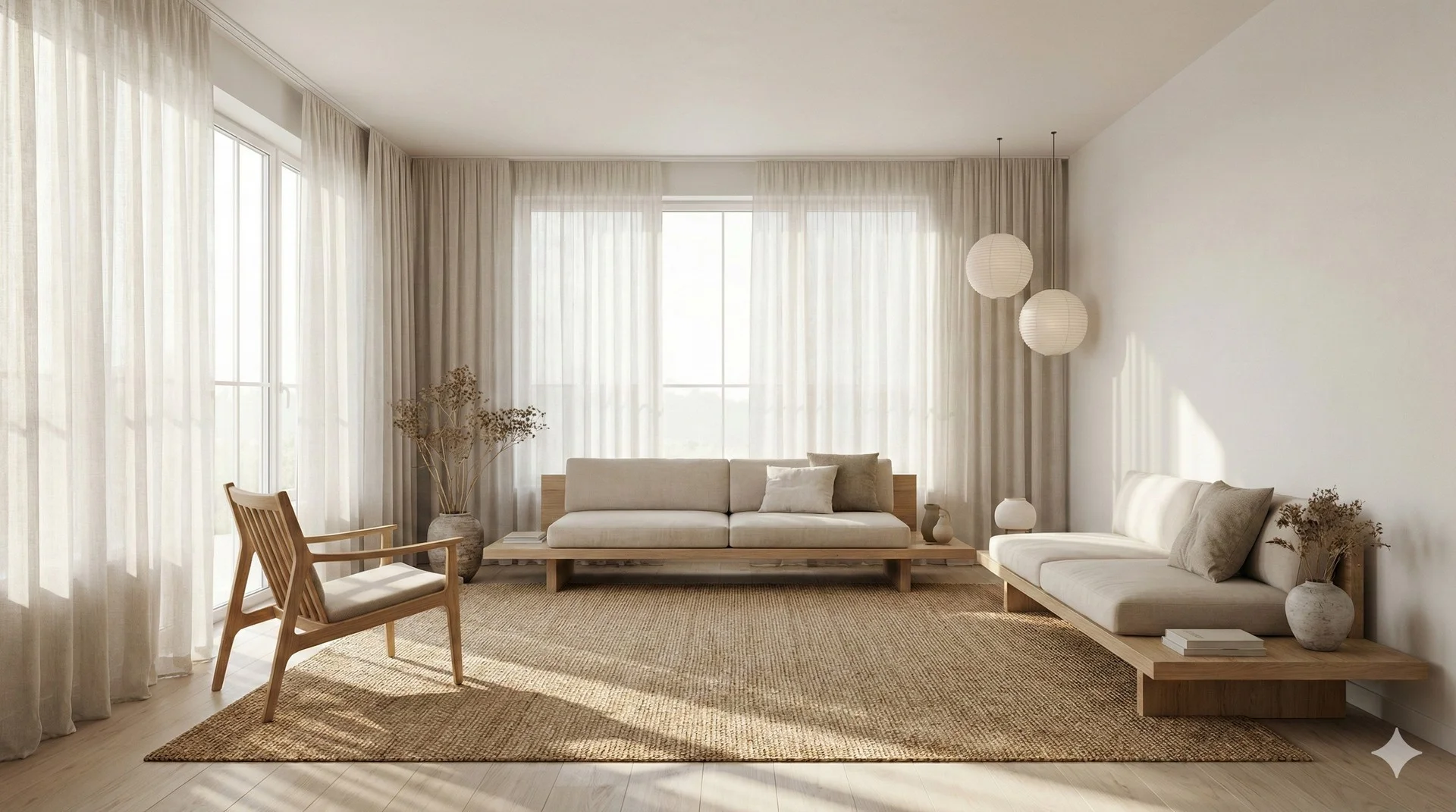
Minimalism has spent two decades being misunderstood. Somewhere along the way, the public conversation collapsed the idea into something thin and cold — white walls, a single grey sofa, one spindly cactus, no rugs, no warmth, no joy. The kind of room that photographs well for a real-estate listing and feels like a dentist's waiting area when you actually walk into it. That is not minimalism. That is a room with nothing in it.
Real minimalist interior design is one of the most demanding and rewarding styles in the entire design vocabulary. It produces homes that age beautifully, calm the nervous system, and reveal their depth slowly. The discipline is not about removing things — it is about making sure every single thing that stays is doing real work. This guide is about how to do minimalism so that your home feels considered and warm, not empty and cold.
The Difference Between Minimalism and Sparse
A sparse room has too few things. A minimalist room has exactly enough things. The two often look similar in photographs, but they feel completely different in person. Sparse rooms read uncomfortable, performative, and slightly anxious — as if the homeowner is afraid of clutter. Minimalist rooms read calm and grounded — as if the homeowner already considered every object and chose what stayed.
The reliable test: walk into the room and try to remove one object. In a sparse room, removing something makes the room feel slightly better — more breathable. In a true minimalist room, removing anything makes the room feel slightly worse — less complete. Every piece is load-bearing.
Less, But Better: The Dieter Rams Principle
The clearest articulation of real minimalism came not from an interior designer but from the German industrial designer Dieter Rams, who shaped Braun products in the 1960s. His principle was weniger, aber besser — less, but better. The point was never quantity. The point was quality high enough that you needed less of it.
Applied to interiors, the principle becomes a constant editing question: is this object good enough on its own that nothing needs to be near it? A beautiful linen chair in an empty corner is minimalist. The same chair with a side table piled with magazines, a floor lamp, a throw pillow, and a stack of books is contemporary. Both can be beautiful. Only one is minimalist.
This is why minimalism is hard. It demands that every object earn its place against an empty wall, not against a backdrop of other objects. The bar is much higher than people assume.
The Color Strategy: Not Just White
The single biggest misconception about minimalism is that it is white. Strict white-on-white minimalism exists, but it is the most brittle and least livable version of the style. The minimalism that actually feels good in real homes is built on warm monochromatic depth: three to five tones of the same family stacked on top of each other.
A working minimalist palette looks like this:
- Wall color — a warm off-white with a slight yellow or pink undertone (Farrow & Ball's Strong White, Benjamin Moore's White Dove, or Portola's Bone). Never Brilliant White.
- Floor — pale oak, ash, or a warm sand-colored concrete or stone. Cool grey LVT will undo everything.
- Soft furnishings — oat, cream, mushroom, taupe. Slight tonal variation gives the eye somewhere to rest.
- One darker accent — a charcoal lamp base, a near-black picture frame, a dark wood sideboard. The contrast anchors the room and stops it floating.
Cold minimalism uses Brilliant White, grey concrete, chrome, and glass. Warm minimalism uses bone white, pale oak, brushed nickel or matte black, and linen. The two styles look nearly identical in plan and completely different to live in.
Furniture: Every Piece Earns Its Place
The minimalist furniture rule is straightforward: no filler furniture. No accent chairs that no one sits in. No console tables that exist to hold a vase. No nesting tables that came as a set. Every piece must answer two questions — what does it do, and does it look beautiful when nothing is on it.
The pieces that earn their place reliably in minimalist rooms:
- One generous sofa, in a neutral natural fabric, with clean unfussy lines
- One coffee table — heavy, simple, sculptural, ideally in a single material (solid wood, stone, or matte ceramic)
- One side chair or lounge chair, positioned to converse with the sofa rather than fill a corner
- One dining table, with chairs that pull cleanly under it
- One bed, ideally a low platform or a simple upholstered frame with no nightstands taller than the mattress
What is not on this list: anything labeled "accent." Accent chairs, accent tables, accent rugs. The word itself betrays the problem — these pieces are added to break monotony, which means the room was probably going to be boring without them. A minimalist room solves boredom with proportion and material, not with extra furniture.
"Real minimalism is not the absence of things. It is the presence of only the things that matter, given enough room to actually be seen."
Storage as a Design Element
The single most important practical truth about minimalist homes: they require more storage, not less. The visible discipline is only possible because the invisible storage is generous. Books, paperwork, sports equipment, kids' toys, cleaning supplies, seasonal clothing — all of it has to live somewhere. In a minimalist home, that somewhere is integrated, hidden, and abundant.
The reliable patterns: full-height built-in wardrobes with handle-less push-to-open doors, kitchen pantries behind floor-to-ceiling cabinetry, bench seats with lift-up storage, beds with integrated under-storage, and one or two beautiful freestanding pieces (a wooden sideboard, a tall narrow cabinet) that close completely and hide whatever is inside them.
If your home does not have generous integrated storage, minimalism will feel like a daily war against clutter. Address the storage before you address the aesthetics.
Lighting in Minimalist Design
Light is the single biggest difference between a minimalist room that feels serene and one that feels sterile. The rules:
- Natural light is the priority. Maximize it. Window treatments should be sheer or absent. Heavy curtains kill minimalism.
- Warm temperature, always. 2700K bulbs everywhere. 3000K maximum. Cool-white bulbs (4000K and above) will flatten the room into something clinical regardless of every other correct choice.
- Multiple low light sources, not one ceiling source. A floor lamp behind the sofa, a table lamp on a sideboard, perhaps a wall-mounted reading lamp. Layered low light reads warm. A single ceiling downlight reads institutional.
- Hide the bulb when possible. Diffused lampshades — linen, paper, opal glass — read calmer than exposed bulbs.
Common Minimalism Mistakes
The five most common ways minimalist rooms fail in practice:
- Forgot texture. Color restraint is necessary; texture restraint is fatal. A minimalist room needs at least three or four distinct textures (linen, wood grain, stoneware, wool) to keep the eye engaged. Without texture, the restraint reads as poverty rather than discipline.
- Picked Brilliant White. The default white on a paint can will read blue under most indoor lighting and make the room feel cold. Always pick a white with a warm undertone.
- Chrome and glass everywhere. Both materials are cold and reflective and amplify a clinical reading. Substitute brushed nickel, matte black, brass, and matte ceramic.
- Skipped the rug. A bare wood or stone floor under a minimalist sofa is the fastest way to make a room feel unfinished. A simple flat-weave wool or jute rug, sized so the front legs of the sofa sit on it, grounds the whole space.
- Overly curated emptiness. A bookshelf with one book per shelf is performative, not minimalist. Real minimalism allows full shelves — just thoughtfully arranged.
Using AI to Test Minimalist Variations in Your Actual Room
The honest problem with minimalism is that it depends heavily on the bones of your room. A high-ceilinged loft with broad windows falls into warm minimalism almost effortlessly. A small north-facing bedroom with a low ceiling needs different choices — warmer wall color, more texture, lower furniture — to make the same style work. The cheapest way to find out which version of minimalism fits your room is to see it before committing.
Take one photo of your room at hip height, corner-to-corner, in natural daylight. Upload to Decorb. Generate three variations — a strict cool minimalist version, a warm minimalist version with oak and oat tones, and a Japandi-leaning version. Compare them side by side. The room that makes you exhale when you look at it is the one to commit to.
A useful starting prompt: "Warm minimalist living room, bone-white walls, pale oak floor, oat linen low-profile sofa, single sculptural ceramic coffee table, one matte-black floor lamp, soft afternoon daylight, no clutter."
Choose with Information, Not Imagination
Minimalism rewards patience. Most rooms that fail at it failed because the homeowner bought too quickly, before they could see what the room actually needed. The few pieces that survive in a minimalist room have to be exactly right, which means seeing them in context before you commit. For the broader framework, read the full AI interior design guide.