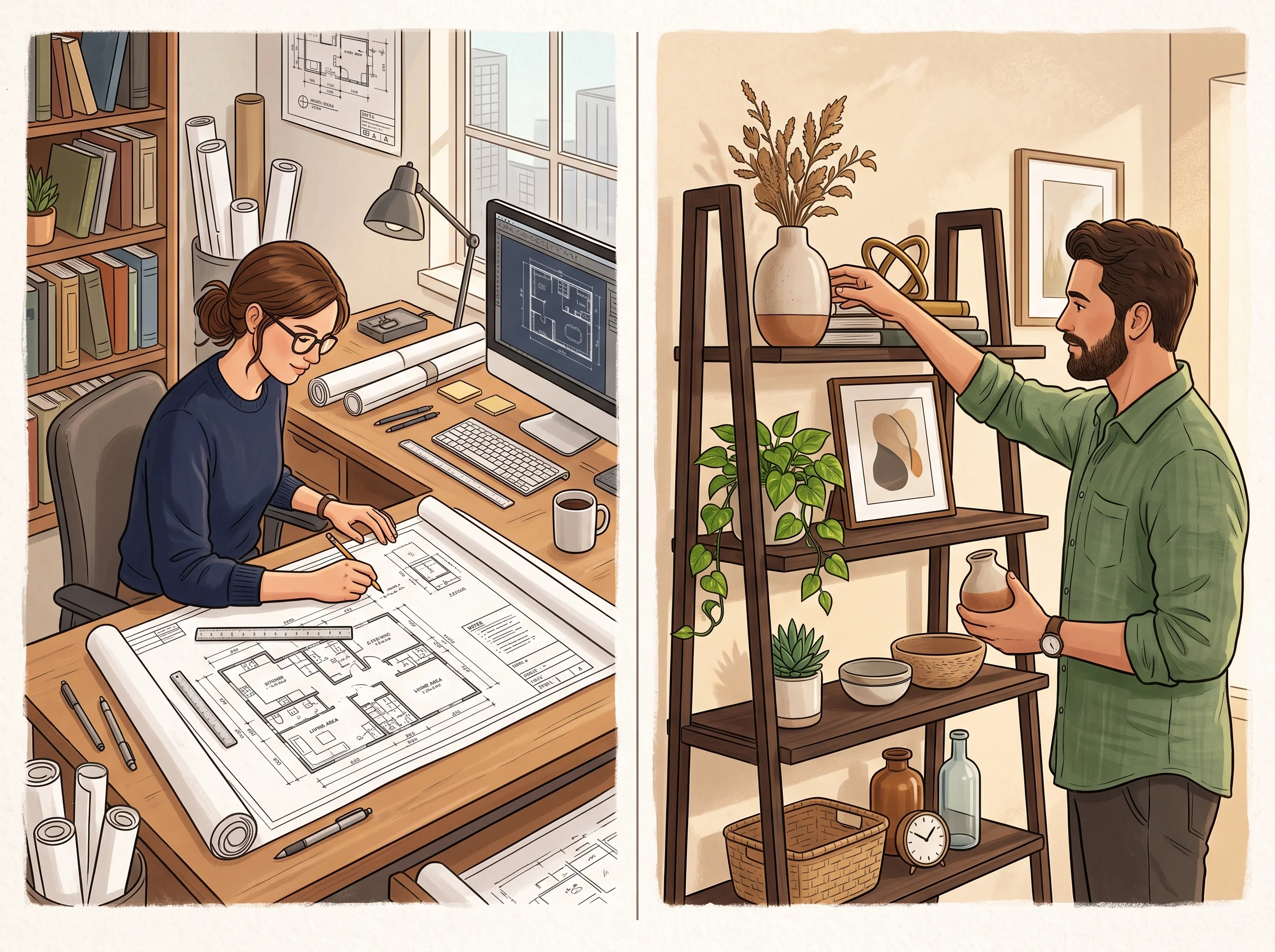
People use "interior designer" and "interior decorator" interchangeably all the time, and most of the time it doesn't cause any harm. But when you're about to hire one — or spend a significant amount of money on your home — the difference matters. Hiring a decorator for a project that needs a designer can leave you stuck. Hiring a designer for a project that only needed a decorator can leave you overpaying for credentials you'll never use.
Here's the honest breakdown of what actually separates the two, what the law does and doesn't say, and a simple test for figuring out which one your project requires.
The Formal Distinction
On paper, the two roles are genuinely different professions. Interior designers typically have formal education — often a bachelor's degree in interior design — and study things like building codes, space planning, materials, and construction documentation. Some go further and earn NCIDQ certification, the industry's main professional credential, which requires education, documented work experience, and passing a rigorous exam. Crucially, designers are trained to work with structural and code-related elements: they can plan layouts that involve moving walls, reconfiguring plumbing, adjusting lighting circuits, and coordinating with architects and contractors.
Interior decorators focus on aesthetics. Their domain is the visible, movable, changeable layer of a room — furniture, color palettes, window treatments, rugs, art, accessories, and styling. Decorators don't typically need formal design education, and they don't touch structure. Their expertise is taste, composition, and pulling a look together. A great decorator can make a space feel transformed without a single permit or contractor involved.
So the clean version is: designers can change the box, decorators work within the box.
What the Law Actually Says
Here's where the neat distinction gets messier. In practice, the terms are far less protected than most people assume. In the United States, the majority of states do not legally protect the title "interior designer." That means, in many places, someone can call themselves an interior designer without holding a specific degree or certification. A handful of states have title acts or practice acts that regulate who can use certain titles or perform certain design work, but they're the exception rather than the rule.
The word "decorator" is even less regulated. Anyone can use it. This isn't a scandal — plenty of enormously talented decorators built their skills through experience rather than a classroom — but it does mean the title alone tells you very little. What matters is what the person can actually do and what your project actually needs.
"The title on the business card is a weak signal. The real question is whether your project touches structure — and that answer decides who you need."
The Test That Actually Determines Who You Need
Forget the credentials for a moment. There's one question that cuts through everything: does your project touch walls, wiring, plumbing, or require permits?
If the answer is yes — you're moving a wall, relocating a sink, rewiring for new lighting, opening up a kitchen, or doing anything that a city inspector would want to sign off on — you need an interior designer, or in some cases an architect. This is work with structural and legal consequences, and it requires someone trained to handle building codes and coordinate trades. A decorator is not equipped for this, and it isn't their job to be.
If the answer is no — you're choosing furniture, picking paint colors, selecting a rug, arranging a layout within the existing walls, styling shelves, updating window treatments — then you're firmly in decorating territory. You need a decorator, or increasingly, a good AI visualization tool that handles the same aesthetic decisions. No structure is changing. Nothing needs a permit. The entire project lives in the visible, movable layer.
Most homeowners, when they're honest about their project, land in the second category. They don't want to move walls. They want their space to look better with what's already there.
The Cost Difference
Credentials cost money. NCIDQ-certified interior designers typically charge more than decorators, and reasonably so — they carry more training, more liability, and the ability to handle technical work. If your project genuinely requires structural changes, that premium is money well spent, because the alternative is expensive mistakes with your home's bones.
But if your project is purely aesthetic, paying designer rates for decorator work is simply overpaying. You're buying capabilities — code knowledge, construction documentation, contractor management — that your project will never use. This is one of the most common mismatches homeowners make: they assume "designer" means "better," hire accordingly, and pay a premium for structural expertise on a project that never touches structure.
The Third Option Most People Actually Wanted
Here's the part that reframes the whole question. When homeowners hire a decorator, what they're usually paying for is a set of aesthetic and visual decisions: what will this room look like with a different sofa, a warmer palette, a new layout, a specific style direction? That's the core deliverable. And that's precisely the kind of decision AI visualization tools now handle at near-zero cost.
You upload a photo of your room, and you can see it restyled — different furniture, different colors, different moods — in seconds. The aesthetic exploration that a decorator would charge hourly rates for becomes something you can do yourself over a weekend, iterating as many times as you like. For the large category of projects that are about taste rather than structure, this covers most of what people actually needed from a decorator in the first place.
None of this replaces a designer when structure is involved — nothing about AI can pull a permit or move a load-bearing wall. But for the aesthetic layer, which is where most home projects live, it changes the math entirely.
A Simple Way to Decide
Run your project through a quick filter. Are you changing the structure, the wiring, the plumbing, or anything requiring a permit? Hire an interior designer. Are you working within the existing walls, focused on how the room looks and functions with furniture and finishes? You need a decorator's skill set — which you can get from a decorator or an AI tool, depending on your budget and how hands-on you want to be.
The mistake to avoid is defaulting to the more expensive, more credentialed option out of caution when your project doesn't call for it. Match the professional to the work. For structural projects, a designer's training is irreplaceable. For aesthetic projects, you have more affordable, faster options than you did even a couple of years ago — and they cover the decisions that actually make a room feel like yours.