Every year the design world publishes its trend forecasts, and every year homeowners face the same quiet dilemma: which of these are worth acting on, and which are just this season's version of last season's mistake. The honest answer is that most trends are neither timeless nor worthless — they are signals about where the collective mood is heading, and the skill is in reading the direction rather than chasing the specifics.
The trends defining 2026 share a coherent thread. After years of cold, hard minimalism and disposable fast-furniture, interiors are turning warmer, more natural, more durable, and more personal. Below is the curated set worth understanding — what each one actually means, how to bring it into a real home, and, just as important, what is quietly on its way out. Every look here is testable on your own room before you commit, which is the difference between adopting a trend and regretting one.
The Mood of 2026
If 2026 has a single unifying feeling, it is grounded warmth. The pandemic-era obsession with all-white, all-grey, ultra-minimal spaces has given way to rooms that feel lived-in, tactile, and connected to nature. People are choosing materials that age well over materials that photograph well, colors that comfort over colors that impress, and pieces they intend to keep over pieces they expect to replace. The throughline behind every trend below is a rejection of the cold, the disposable, and the sterile in favor of the warm, the durable, and the human.
Biophilic Design and Natural Materials
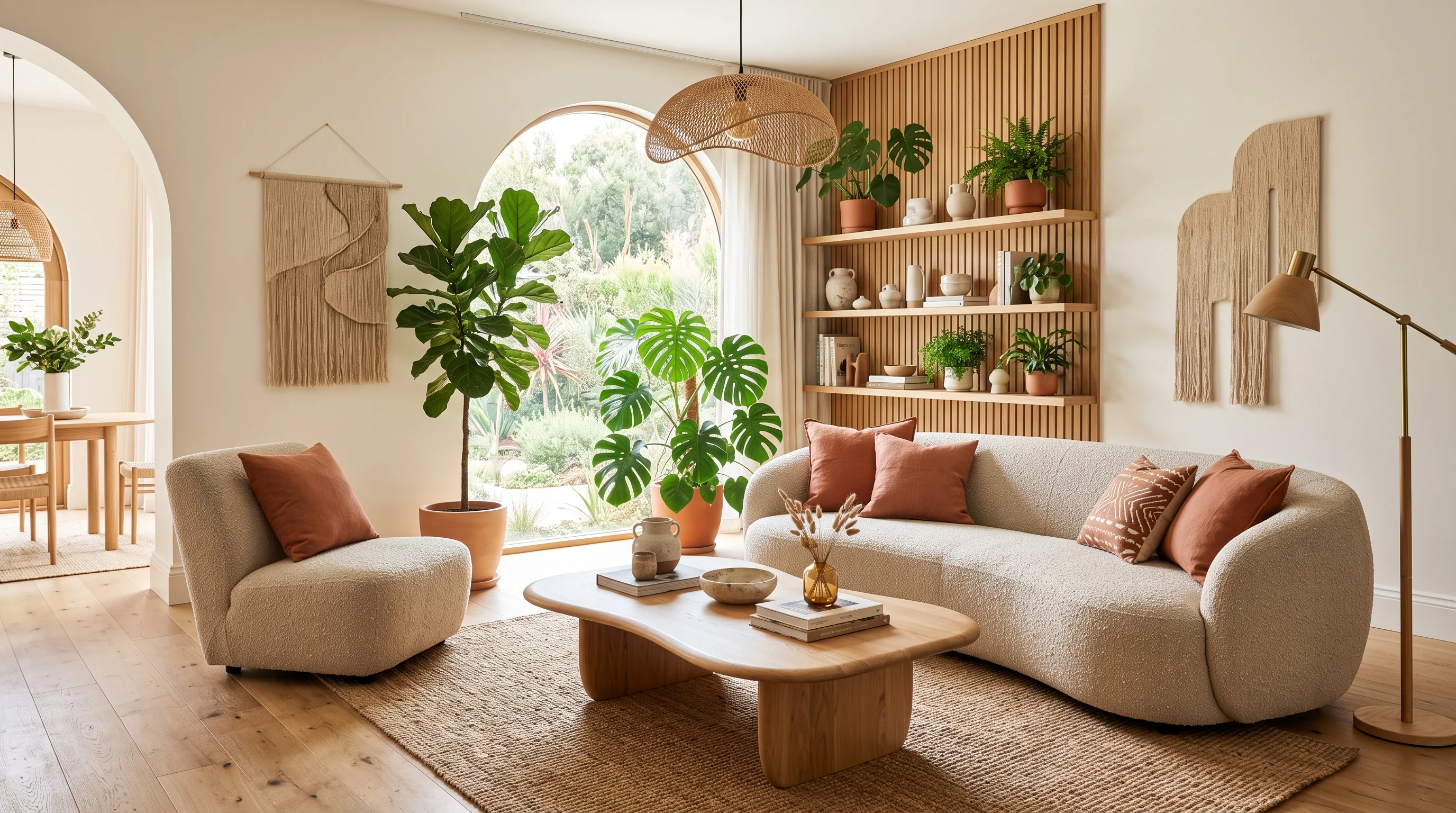
Biophilic design — the practice of connecting interior spaces to the natural world — is the defining movement of 2026, and unlike many trends it rests on real evidence that natural elements reduce stress and improve wellbeing. In practice it means more than adding a few houseplants. It means natural materials with visible character: solid oak and walnut with the grain showing, unlacquered stone, rattan and cane, wool and linen and jute, unglazed terracotta and stoneware ceramic.
It also means designing around natural light — maximizing it, layering warm artificial light to mimic it, and choosing window treatments that filter rather than block. And it means bringing greenery in at scale: not one sad plant on a shelf, but generous, healthy plants treated as architecture. The palette leans earthy — warm terracotta, clay, moss and sage green, oat, sand, and the honey tones of natural wood. If this direction appeals to you, our Japandi guide covers a closely related natural-materials aesthetic in detail.
Sustainable and Conscious Design
Sustainability has moved from a marketing badge to a genuine buying principle. In 2026, conscious design shows up as vintage and secondhand furniture chosen over new (both for character and for footprint), pieces built to last and be repaired rather than replaced, and a preference for natural, low-impact, and recycled materials — reclaimed wood, natural fiber textiles, low-VOC paints, recycled glass and metal.
The aesthetic payoff is real: a room furnished with a few well-chosen vintage pieces has a depth and story that a showroom-fresh matching set cannot buy. Patina, age, and the evidence of a previous life read as warmth. The practical payoff is durability — buying once and buying well is both greener and, over time, cheaper. This trend rewards patience: the hunt for the right vintage sideboard is part of the point.
"The most durable trend of 2026 is not a color or a material — it's the decision to buy fewer things, keep them longer, and choose each one deliberately."
Warm Minimalism vs Cold Minimalism
Minimalism is not dead — it has evolved. The stark, cold minimalism of the last decade (all white, all hard surfaces, nothing on display) has given way to warm minimalism: the same restraint and calm, but delivered through warm materials and soft textures instead of empty sterility. A warm-minimalist room keeps the uncluttered discipline but swaps cool grey and gloss for warm oak, oat linen, stoneware, and layered warm light.
The distinction matters because it is the difference between a room that feels serene and one that feels clinical. Cold minimalism reads like a gallery you are not allowed to touch. Warm minimalism reads like a calm place you want to stay in. If you want the full philosophy of doing minimalism without making a home feel empty, our minimalist interior design guide breaks down exactly how the warm version works.
Color and Texture Trends
After years of grey-on-grey and beige-on-beige, color is returning — but with restraint. The 2026 palette is not loud; it is rich and earthy. Expect to see:
- Warm earth tones — terracotta, rust, clay, ochre, and warm browns used as grounding colors, not just accents.
- Deep, moody greens — forest, olive, and sage on cabinetry, feature walls, and upholstery, bridging the biophilic and color trends.
- Soft, buttery neutrals — warm off-whites and creams replacing cold greys as the default backdrop.
- Muted jewel accents — burgundy, ochre-gold, and deep teal introduced sparingly through textiles and single pieces.
Texture is doing as much work as color. The flat, matte, minimal surfaces of recent years are giving way to tactile variety: boucle and sheepskin, chunky knits, fluted and reeded wood detailing, plaster and lime-wash wall finishes with visible depth, and handmade tile with irregular surfaces. A 2026 room is meant to be touched, not just seen.
Curved Forms and Statement Shapes
One of the more visible shifts of 2026 is a move away from the hard, rectilinear, right-angled furniture that defined the previous decade toward soft, curved, organic forms. Rounded-arm sofas, kidney-shaped and oval coffee tables, arched mirrors and doorways, curved-back dining chairs, and pouffe-style seating are everywhere in the forecasts, and the reason is emotional as much as visual: curves read as calming, welcoming, and human, while sharp edges read as formal and cold. In a design year defined by warmth and comfort, the softening of silhouette is the logical expression of the same instinct.
Curves also pair naturally with the other 2026 currents — an organic, rounded form in a warm oak or a boucle upholstery sits comfortably inside a biophilic, warm-minimalist room in a way that a hard chrome-and-glass piece never could. The caution is restraint: a room where every single piece is curved can tip into cartoonish. The strongest application uses one or two statement curved pieces — a rounded sofa, an arched mirror — against otherwise clean lines, so the softness reads as intentional rather than as a theme.
Multifunctional and Considered Spaces
The final quiet trend of 2026 is less about a look and more about how rooms are asked to work. As homes continue to absorb work, exercise, and rest into the same square footage, design is responding with multifunctional, zoned spaces: a living room with a discreet work nook, a bedroom with a small reading and meditation corner, an entryway that doubles as a drop-zone and a moment of welcome. The aesthetic goal is to serve multiple functions without the room reading as cluttered or compromised — achieved through smart storage, defined zones, and furniture that earns its place by doing more than one job.
This trend rewards planning over accumulation, which is exactly why previewing a room before you furnish it matters. Seeing how a work nook or a reading zone actually sits within your real space — before you buy the desk or the chair — is the difference between a room that flexes gracefully and one that feels like two competing purposes crammed together.
What's on the Way Out
Trends are defined as much by what they replace. Fading in 2026:
- All-grey everything. The cool grey palette that dominated the 2010s now reads dated and cold. Warm neutrals have taken its place.
- Cold, hard minimalism. Empty rooms with no warmth or personality are giving way to the warm-minimalist evolution.
- Fast, disposable furniture. The buy-cheap-replace-often cycle is losing ground to buy-once-buy-well and vintage.
- All-white kitchens. Still classic, but the pure-white kitchen is being warmed with wood, color, and natural stone rather than left clinical.
- Matchy furniture sets. The single-purchase matching set is out; layered, collected, and mismatched-on-purpose is in.
- Overhead-only lighting. The single harsh ceiling light is finally losing to layered, warm, multi-source lighting.
How to Try a Trend Before Committing
Here is the honest problem with trend articles: reading about warm minimalism or a deep-green feature wall tells you nothing about whether it will work in your room, with your light, your proportions, and your existing pieces. A trend that looks stunning in a magazine's styled Copenhagen apartment can fall flat in a north-facing suburban living room. The gap between the forecast and your reality is where trend regret lives.
The fix is to see it before you buy it. Photograph your room, upload it to Decorb, and generate it in the trend you are curious about — a warm-minimalist version, a biophilic version with natural materials and greenery, a moody-green feature wall version — all rendered in your actual space. Comparing two or three trend directions side by side in your own room tells you in thirty seconds what a hundred Pinterest saves never will: which one actually belongs in your home. Try any 2026 trend on your own room instead of guessing. For the full framework, see our interior design styles guide.
Adopting Trends Without Regret
The safest way to engage with any trend is to put it where it is cheap to change and permanent where it is timeless. Bring 2026 into a room through textiles, paint, plants, decor, and a single considered furniture piece — all reversible or affordable to update. Keep the expensive, hard-to-change elements (flooring, large upholstery, cabinetry) in the durable, timeless choices that will outlast the trend cycle. That way a look that feels fresh now never becomes an expensive mistake later.
And remember that the strongest current in 2026 is not any single color or material — it is the move toward warmth, nature, durability, and personality. A home built on those principles will feel current for far longer than one that chased a specific shade. Choose the direction, test it in your actual space, and commit only to what genuinely belongs there.
One final piece of perspective: trends are a menu, not a mandate. You are under no obligation to adopt any of them, and the most personal, enduring homes tend to borrow lightly from the current moment while staying rooted in what their owners actually love. Use the 2026 forecast as a source of ideas to test rather than a checklist to complete. Pull in the biophilic warmth or the curved sofa or the moody green wall if it genuinely resonates with you and works in your space — and confidently ignore the rest. A home that reflects you, lightly seasoned with the best of the moment, will always outlast one assembled to match a forecast. To go deeper on the calm, natural end of the spectrum, read our guides to minimalist interior design and Japandi style.