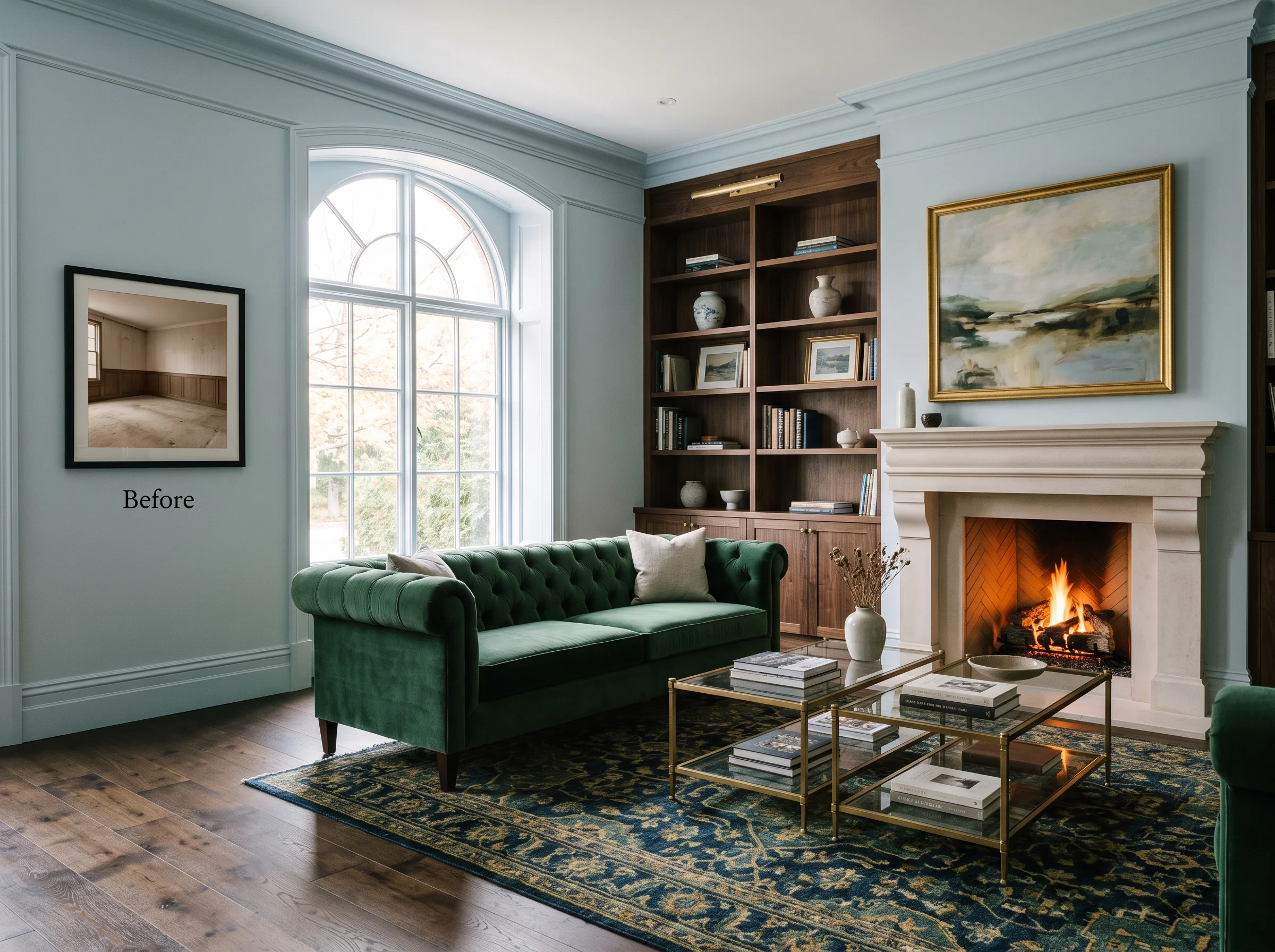
"Is an interior designer worth it?" is really two questions wearing one coat. There's the emotional question — will my home feel better? — and the financial one — will I get my money back? This article is about the second. Not whether design matters (it does), but whether hiring a designer produces a return that justifies the cost. The honest answer is: sometimes clearly yes, sometimes clearly no, and the difference comes down to a few specific factors.
Let's look at what the data actually shows, where designers add real dollars, where the math falls apart, and how to figure out which situation you're in.
What the Research Shows
The strongest evidence for design adding measurable value comes from home sales. National Association of Realtors data has consistently shown that staged homes tend to sell faster and, in many cases, for more money than unstaged equivalents. Estimates of the sale-price bump vary, but a lift in the range of roughly 1 to 10 percent shows up repeatedly, and the faster-sale effect is even more consistent. Staging is design applied to a specific goal, and it demonstrably moves the needle at the point of sale.
Renovation ROI tells a similar story with more nuance. Kitchens and bathrooms consistently return the most of any interior investment — often recovering somewhere in the 60 to 80 percent range of renovation cost at resale, and sometimes more in hot markets. These are the rooms buyers scrutinize most, and thoughtful design of them pays back a large share of the spend. Other rooms return less. And there's a quieter finding worth noting: designer-managed renovations tend to produce fewer costly mistakes and fewer contractor overruns than DIY-managed ones, which is a form of value that never shows up as a line item but absolutely affects the total cost.
Where Designers Add Clear ROI
Four situations stand out where a designer's fee reliably pays for itself.
The first is mistake prevention. Buying the wrong furniture is expensive — a sofa that doesn't fit, a dining set at the wrong scale, a custom order in the wrong finish can cost $2,000 to $8,000 to correct, and often it simply can't be undone. A designer who steers you away from those mistakes saves money that never appears on an invoice but is very real. The second is contractor coordination. Unmanaged renovations routinely run over budget — overruns averaging around 25 percent are common — because of poor sequencing, miscommunication, and change orders. A designer acting as project manager keeps that in check, and on a large renovation, that discipline alone can exceed their fee.
The third is trade access. Designers often get to-the-trade pricing, with discounts in the 20 to 40 percent range on furnishings and materials. On a large project, those savings can offset a meaningful chunk of the design fee — though on a small project, the fee can outweigh the discount, so this cuts both ways. The fourth is resale staging value, the well-documented lift in sale price and speed discussed above. When you're selling, professional staging is one of the most reliable design investments there is.
"A designer's biggest financial contribution is often the mistake you never make — the wrong sofa unbought, the overrun uncaused. It's real value that never appears on the invoice."
Where the ROI Breaks Down
Now the honest counterweight. The math stops working on purely aesthetic, single-room projects where the designer's fee exceeds the value of the decisions they're making. If you're refreshing one bedroom — new paint, a rug, some furniture, better lighting — and the design fee is a large fraction of the total budget, you're paying a premium for taste on a project small enough that the taste doesn't compound into meaningful financial return.
In these cases the decisions are real but modest: which of a few good sofas, which of a few nice palettes. There's no contractor to coordinate, no structural risk to manage, no large purchase to get wrong, no resale event on the horizon. The value a designer adds is genuine but small, and the fee can easily swallow it. Paying full designer rates to choose between three attractive options for one room is where "worth it" turns into "overpaying."
The Value Framework
| Situation | Does a Designer Add Clear Value? |
|---|---|
| Full renovation above $15k–$20k budget | Yes — coordination and mistake prevention pay off |
| Kitchen or bath remodel | Yes — highest-ROI rooms, high complexity |
| Staging a home for sale | Yes — measurable lift in price and speed |
| Complex project with multiple contractors | Yes — overrun prevention exceeds the fee |
| Single-room aesthetic refresh | Rarely — fee often exceeds decision value |
| Choosing furniture and colors, no structural work | Not usually — AI visualization covers it |
Where the Threshold Sits
Pulling the framework together, a rough but useful rule emerges. A designer adds clear financial value above roughly $15,000 to $20,000 in project budget, especially where execution complexity is high — multiple trades, structural changes, kitchens and baths, or a sale on the horizon. Above that threshold, the mistake-prevention, coordination, trade-pricing, and resale effects are large enough that the fee is an investment that returns more than it costs.
Below that threshold, on smaller aesthetic projects, the calculation flips. When the work is really about visual decisions — furniture, color, style, layout — AI visualization plus careful, self-directed purchasing often matches the outcome at a fraction of the cost. You get to see the options, avoid the obvious mistakes by testing before you buy, and make confident choices without paying a fee that would exceed the value of the choices themselves. The part of the designer's job that mattered most on a small project — helping you see and decide — is precisely the part that's now cheaply available.
The Honest Answer
Do interior designers add real value to your home? Yes — clearly and measurably — when the project is large, complex, involves kitchens or baths, requires contractor coordination, or is aimed at a sale. In those situations, mistake prevention, overrun control, trade pricing, and staging returns routinely exceed the fee. The designer isn't a luxury there; they're a sound investment.
But on small, purely aesthetic projects, the value the designer adds is often smaller than what they charge. That's not a knock on designers — it's a matter of matching the tool to the job. For those smaller projects, the visual decisions that used to require a professional are now something you can handle yourself, seeing your options on your real room before you commit a dollar. Know which situation you're in, and you'll spend your money where it actually earns its keep.