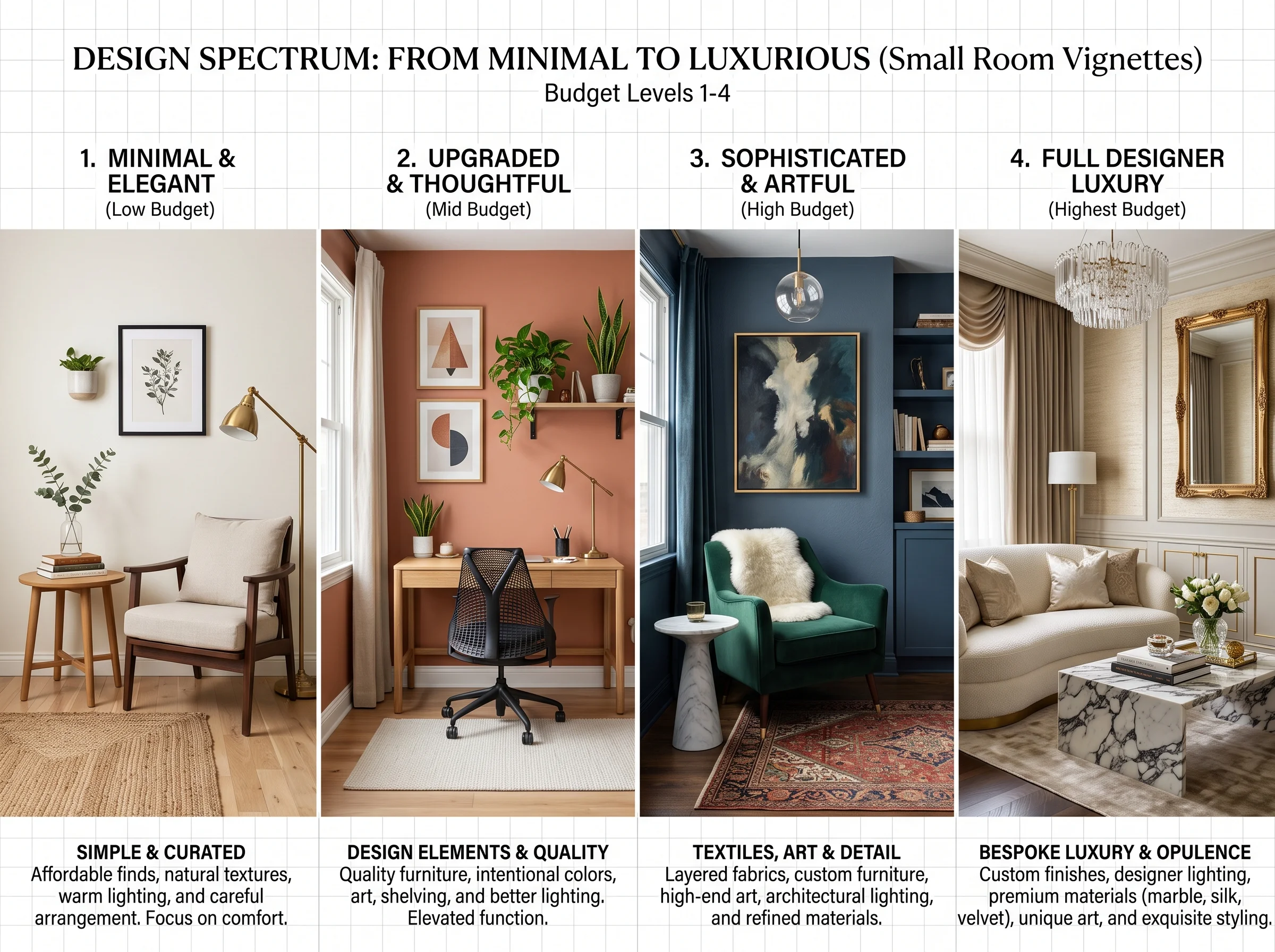
"How much should I budget for interior design?" is one of those questions where the honest answer is a range so wide it's almost useless: anywhere from zero to more than thirty thousand dollars for a single room. The number that's right for you depends less on your taste and more on one question — is your project mostly about deciding how things should look, or about physically making them happen?
Let's lay out the full spectrum of what you can pay, what each level actually delivers, and how to land on the tier that fits.
The Full Spectrum of Design Services
Here's every rung on the ladder, from free to premium, with what your money actually buys at each.
AI tools — $0 to $50/month. Full photorealistic visualization of your actual room, unlimited style exploration, and furniture and color testing before you buy. What you don't get: any execution support, sourcing, or contractor help. This is pure visual decision-making, and it covers that part completely.
Online design consultation — $100 to $500 for a single session. An hour or two with a professional who gives you style direction and maybe a shopping list. Useful for unsticking yourself, but there's no follow-through — you're on your own after the call.
E-design package — $500 to $1,500 per room. A remote, deliverable-based service: you send photos and measurements, they send back a style guide, a mood board, and a shopping list. No one sets foot in your home and no contractors are involved. Great for a visual refresh you'll execute yourself.
Hybrid service — $1,500 to $5,000 per room. A design concept plus some real sourcing — they'll actually pull products, sometimes with trade pricing, and hand you a more complete plan. Still mostly your job to install and manage.
Partial-service designer — $3,000 to $10,000. Concept through procurement. They design it, source it, and order it, but you manage the contractors and the install. A strong middle option for a substantial room.
Full-service designer — $10,000 to $40,000+ per room. Everything, end to end: concept, sourcing, trade coordination, project management, and installation. You hand over a room and get it back finished. This is what large renovations and clients who want zero involvement pay for.
The Question That Decides Your Tier
Before you match a number to your project, answer this: is your project primarily visual decision-making or physical execution?
If it's visual — you want to choose colors, furniture, layout, and style, and you're comfortable buying and arranging things yourself — then AI tools and e-design cover you at the low end of the range. Paying for full service here mostly buys convenience, not better decisions.
If it's physical — walls moving, trades to coordinate, custom millwork, a timeline to manage — then the higher tiers add genuine value, because you're paying for project management and execution that no visual tool can provide.
"The right design budget isn't a fixed number. It's a function of one thing: how much of your project is choosing versus building."
How to Allocate Within Your Budget
Once you've picked a tier, spend the money where it's felt. The principle professionals use: invest most in the things you touch every day and least in the background. The sofa you sit on for hours, the mattress you sleep on, the flooring underfoot — these deserve real money because you interact with them constantly and cheap versions reveal themselves fast. The accent objects, the seasonal decor, the things you look at but rarely touch — spend little there.
As a rough planning guideline, the design service fee itself tends to run about 10 to 15% of your total project budget. If you're putting $20,000 into a room's furniture and finishes, a $2,000 to $3,000 design fee is proportionate. If your "service" is a $30/month AI subscription against that same $20,000, you're spending almost nothing on the decision layer and putting the money into the room itself — which, for a purely visual project, is exactly right.
Getting Professional Results at Every Budget
Here's the part that surprises people: the quality of the design decisions doesn't have to scale with what you spend on services. A well-executed room built on AI exploration and disciplined self-shopping can look every bit as considered as a full-service project, because the visual choices — scale, color, restraint, layout — are the same regardless of who makes them.
What you're really buying at the higher tiers is time, access, and accountability, not better taste. So the budget-smart move is to spend as little as possible on the layers you can do yourself and reserve real money for the layers you can't — physical execution and the pieces that carry the room. For most single-room projects, that means doing the visual work with a low-cost tool and putting the savings into better furniture.
A Simple Way to Land on Your Number
Start by classifying your project. Pure refresh with no construction? Budget $0 to $1,500 for the design layer (AI tool or e-design) and put everything else into furniture. Substantial room with some sourcing help wanted? $1,500 to $10,000 buys hybrid or partial service. Full renovation with trades and a timeline? Budget 10 to 15% of the total for a full-service designer, because coordination is the real product.
The mistake to avoid is paying full-service prices for a project that's really just visual, or trying to DIY-coordinate a multi-trade renovation to save on a designer who would have paid for themselves. Match the spend to the nature of the work, and the right number becomes obvious.