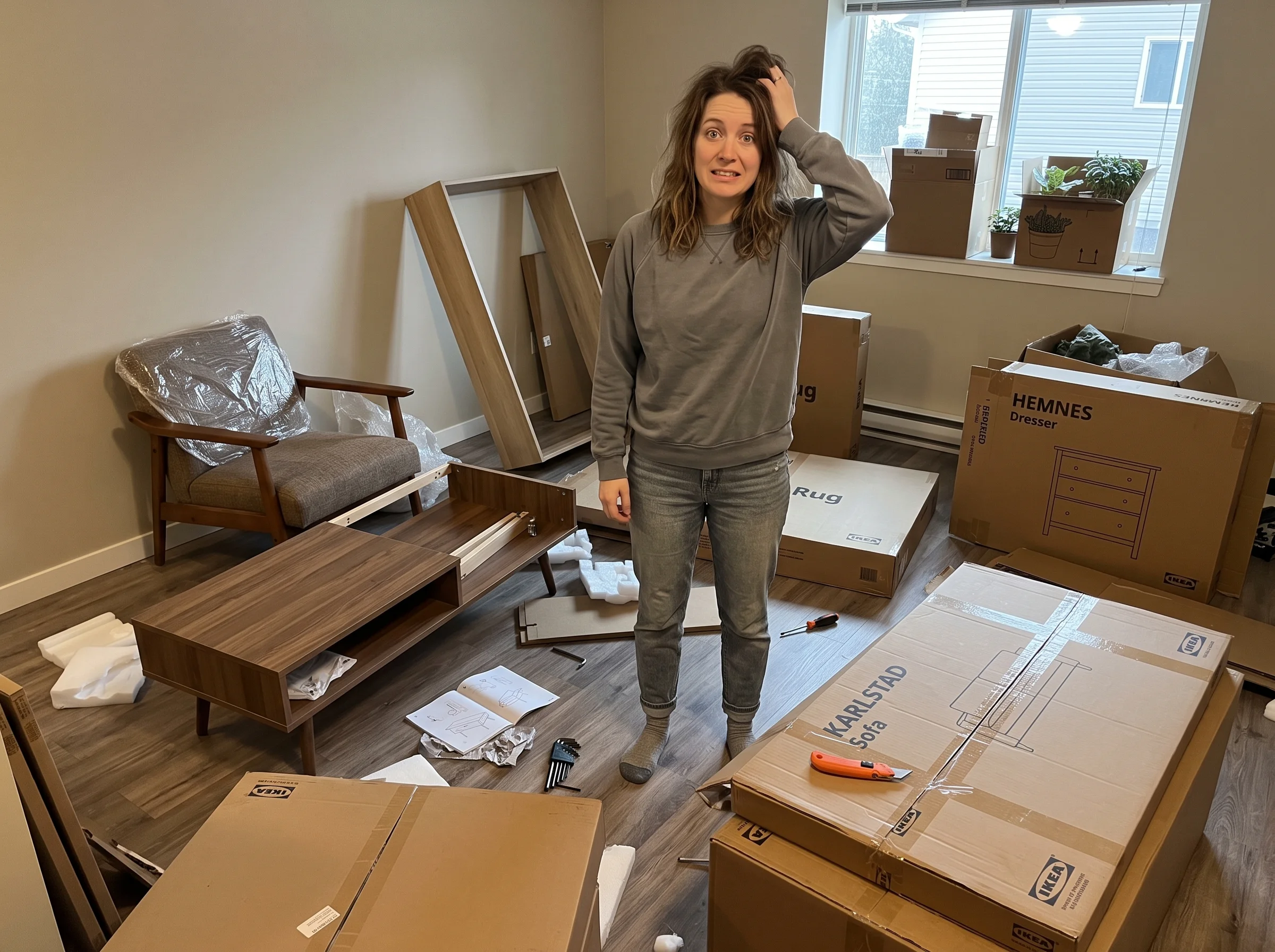
We'd be the last people to tell you to hire a designer for everything. Most single-room refreshes — new paint, updated furniture, better lighting, some styling — are well within reach of a motivated homeowner, especially now that you can visualize the result before spending a dollar. But there's a real line where DIY stops being resourceful and starts being expensive, and knowing where that line is saves you both money and months. Here are the specific signals that you've reached it.
1. You've Bought and Returned Three Sofas
If you're on your third sofa because nothing looks right in the space, stop. This is almost never a taste problem — it's a scale and proportion problem, and it requires expert diagnosis. Something about the room's dimensions, sightlines, or circulation is fighting the furniture, and buying a fourth sofa on instinct will likely fail the same way. A professional can usually see the issue in minutes, where you've spent weeks and a pile of restocking fees. Repeated returns are the clearest signal that the room has a problem you can't see from inside it.
2. Your Renovation Needs Multiple Contractors Sequenced
The moment your project involves several trades — demo, electrical, plumbing, drywall, flooring, finish carpentry — and you don't know what order they go in or who's accountable when something goes wrong, you've left DIY territory. This isn't a design problem anymore; it's a project-management problem. Getting the sequence wrong is genuinely costly: flooring installed before the plumbing is finished, paint before the dust-making work is done. A designer or general contractor who coordinates trades for a living earns their fee here many times over.
3. You Have Budget and Motivation but Can't Decide
This is a subtle one. You've got the money, you've got the drive, but every option seems equally valid — or equally wrong — and you simply cannot commit. That's decision paralysis, and it's not laziness or lack of taste. Sometimes the most valuable thing a professional provides isn't design at all; it's the authority to say "this one," and the confidence to make you believe it. If you've been circling the same decision for weeks, a professional's job is partly to end the circling.
"Sometimes the real value a designer adds isn't taste — it's forcing a decision. If you've been circling the same choice for weeks, that's the signal."
4. You're Renovating to Sell and Don't Know What Adds Value
Designing for resale is a completely different game from designing for yourself. What you love and what returns value in your specific market are often not the same thing, and the wrong improvements can cost more than they add. If you're renovating to sell and you don't know which upgrades actually move the needle in your neighborhood and price band, that local, market-specific knowledge is worth paying for — a designer or a savvy agent will steer you away from expensive choices buyers won't reward.
5. Your Space Has Architectural Challenges
Generic design advice assumes a reasonably normal room. When your space has real architectural challenges — very low ceilings, an oddly shaped footprint, no natural light, awkward structural columns — the standard playbook stops working, and you need someone who solves these specific problems for a living. These rooms punish trial and error, because the fixes are non-obvious and often counterintuitive. A professional who has handled a dozen dark, oddly-shaped rooms can do in one visit what you'd spend a season failing at.
Before You Call: Exhaust the Visualization Phase
Here's the important caveat, because a few of these signals — especially decision paralysis — can sometimes be resolved without hiring anyone. Before you reach for a designer, exhaust the AI visualization phase first. Generate ten to twenty concepts of your actual space in different styles, directions, and layouts. A surprising amount of "I can't decide" turns out to be "I can't picture it," and once you can see the options rendered in your real room, the right one often becomes obvious.
This matters for a practical reason: the exploration phase is exactly the part of a designer engagement that's slow and expensive. If you can do it yourself in an afternoon and arrive at clarity, you may not need to hire anyone — or if you do, you'll hand them a finished brief instead of paying for their discovery hours.
The Real Signal to Hire
Here's the clean rule that ties it all together. If, after thorough AI exploration — genuinely trying many directions in your actual space — you still can't find a direction, that's the signal to bring in a human. It means the difficulty isn't a lack of visualization; it's a real design or structural problem that needs expert judgment. Likewise, anytime the project crosses into sequencing trades, resale strategy, or serious architectural challenges, the professional earns their fee regardless of how clear your vision is.
DIY doesn't fail because you're not capable. It fails at specific, identifiable points: repeated furniture returns, multi-trade coordination, genuine decision paralysis that survives exploration, resale-value decisions, and architecturally hard rooms. Learn to recognize those five, do the visualization work first, and you'll know exactly when to keep going yourself and when it's time to call someone.