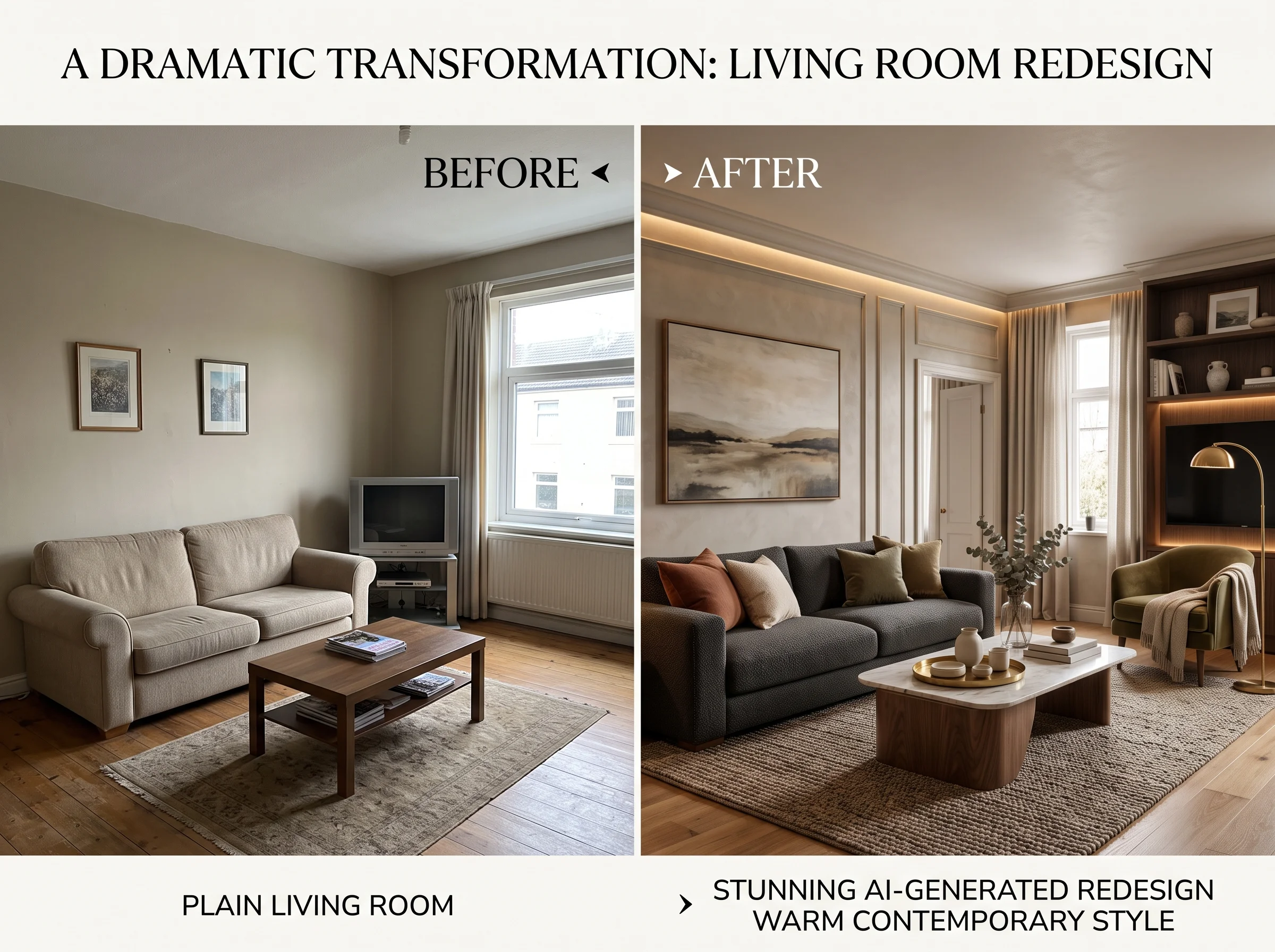
When people ask whether AI can create 3D renderings of their space, they're usually picturing the thing they've seen in real estate listings and design portfolios: a computer-built model of a room, viewable from any angle, lit and textured to look photographic. The honest answer is nuanced, and it's more interesting than a simple yes or no. AI does not build that kind of model. What it does instead turns out to be more useful for most homeowners than a traditional 3D render — and it does it in thirty seconds for pennies instead of thousands of dollars over weeks. Let's unpack exactly what's going on.
How Traditional 3D Rendering Actually Works
Here's the part of the design industry most homeowners never see. When a designer promises you "renderings," they are almost never producing them personally. They outsource the work to a specialized 3D studio or freelancer who builds a digital model of your room in software like SketchUp, then renders it photorealistically using engines like V-Ray or Lumion. It's genuinely skilled work — modeling geometry, applying materials, placing lights, and computing how light bounces around the scene.
It's also slow and expensive. A single room render typically runs $1,500 to $3,000. Turnaround is two to three weeks. And critically, that clock resets with every revision — "can we see it with the darker floor?" is another round, another wait, another invoice. The cost and delay come from the fact that a human has to rebuild or adjust the model each time. This is precisely the pipeline that makes hiring a designer for visualization so slow: you're waiting in a queue behind a studio's other clients.
What AI Photo Rendering Actually Does
AI approaches the problem from a completely different direction. It does not build a 3D model of your room at all. Instead, it takes an actual photograph of your actual space and transforms it — repainting walls, swapping furniture, changing floors, shifting the lighting mood — while keeping the room's real geometry, proportions, and perspective intact. The output is a photorealistic image of your room as it could be.
This distinction sounds like a limitation. In practice it's often an advantage, and here's why: a traditional 3D render is only as accurate as the model someone built, which is an approximation of your room assembled from measurements. An AI photo render starts from your room's ground truth — the actual photograph, with your actual window placement, your actual ceiling height, your actual afternoon light. There's no modeling step to get wrong. You're not looking at a reconstruction of your space; you're looking at your space, restyled.
"AI doesn't build a model of your room — it transforms a photo of it. You're not looking at a reconstruction of your space; you're looking at your space, restyled."
Where AI Rendering Is Exceptional
For the decisions homeowners actually make, AI photo rendering is not just adequate — it's the better tool.
Style exploration. Want to see your living room as Scandinavian, then industrial, then Japandi? That's three renders and about ninety seconds, versus three separate rendering engagements and six-plus weeks. The speed changes how much you explore, and thorough exploration is what produces rooms you love.
Color and palette testing. This is where starting from a real photo shines. Seeing a deep green on your actual wall, in your actual light, tells you something a modeled render approximates but never quite nails, because the AI is working from how light really behaves in your room.
Furniture style decisions. Drop a low mid-century sofa into the frame, then a chunky sectional, and compare them in your space at your scale. For the "which of these two would look right here" question, this is decisive.
Lighting mood changes. Warm evening lamplight versus bright cool daylight transforms how a room feels. AI shifts the entire emotional temperature convincingly, which matters because a room is experienced as a mood, not a floor plan.
Where Traditional 3D Still Wins
Being honest about the boundary is what makes the tool trustworthy. There are jobs where a real, measured, to-scale 3D model is the right answer and AI photo rendering is not.
Precise to-scale architectural models. If a contractor needs to build from your drawing, they need exact geometry — a model where every dimension is real and verified. AI infers proportions from a photo; it does not certify measurements. For construction, you need the measured model.
Exact furniture specifications for custom millwork. A cabinetmaker building a custom built-in works from precise dimensioned drawings, not from an inspirational image. The AI shows the look; the shop drawing specifies the reality.
Legal and permit drawings. Building permits, code review, and structural sign-off require formal, accurate documentation produced by professionals. No AI render substitutes for a stamped drawing.
The pattern is clear: when the render's job is to build something exactly, you need traditional 3D. When the render's job is to help you decide something, AI wins on speed, cost, and relevance to your actual space.
Cost and Speed, Side by Side
| Factor | Traditional 3D |
|---|---|
| Cost per room | $1,500-3,000 |
| Turnaround | 2-3 weeks |
| Cost per revision | Another full round |
| Works from your actual room | Rebuilt from measurements |
| Best for | Construction, permits, millwork |
For the same row on the AI side, read: near-zero cost, thirty seconds, effectively free revisions, works directly from your real photo, and best for decisions about style, color, furniture, and mood. Two tools, two jobs.
The Honest Verdict for Homeowners
If you're a contractor, an architect, or ordering custom millwork, you need traditional to-scale 3D and you should pay for it. If you're a homeowner trying to decide what your room should look like — which color, which sofa, which style, which lighting — AI photo rendering is faster, cheaper by orders of magnitude, and more relevant because it works on your actual space rather than a model of it. The old workflow forced homeowners to buy expensive construction-grade renders just to answer decision-grade questions. AI finally separates the two, and hands you the decision tool directly.