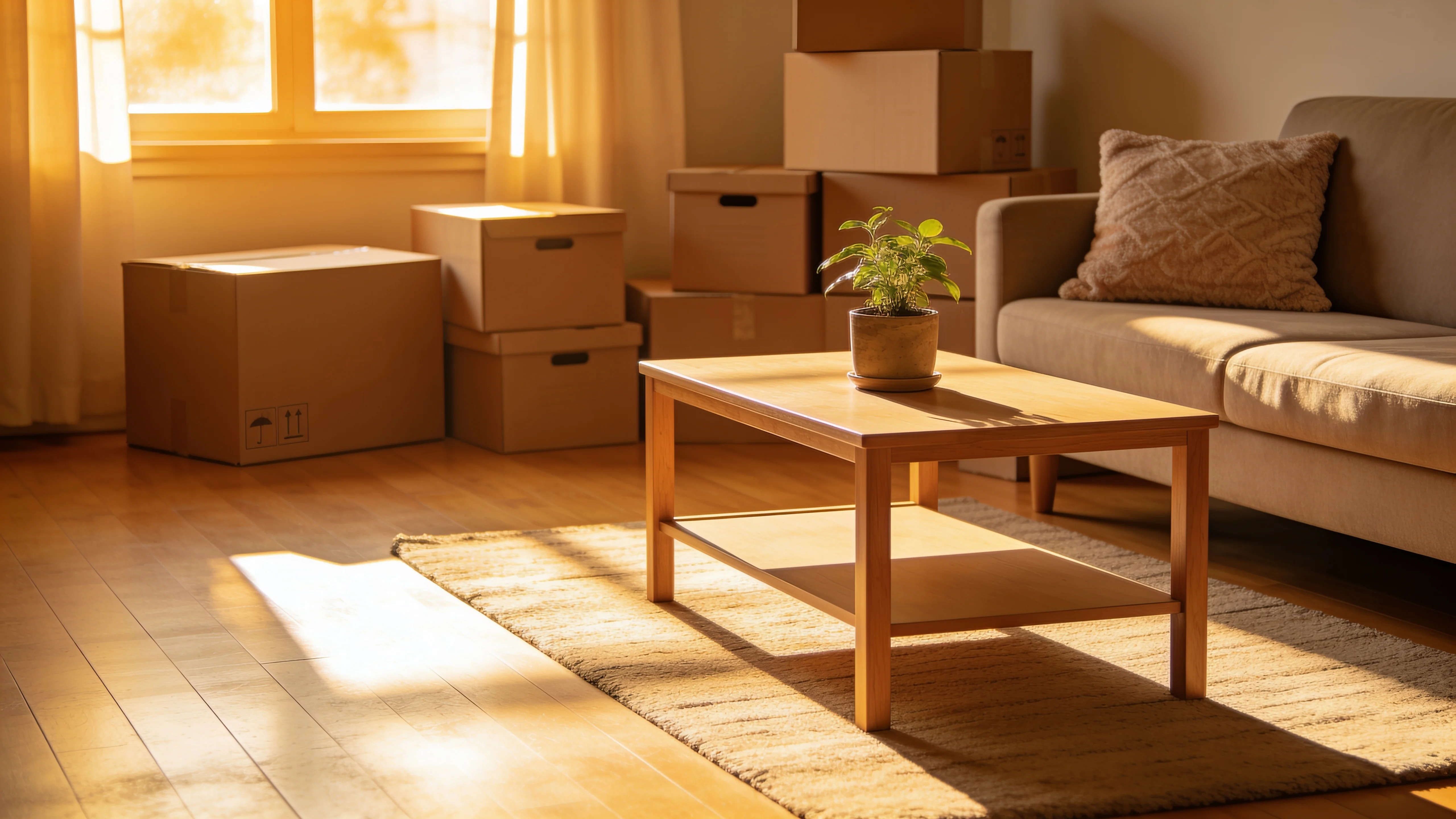
There is a particular quiet that fills a house on the first night after the moving truck leaves. The boxes are stacked, the echo is loud, and the rooms feel like they belong to someone else — or to no one. You signed the papers, you carried the furniture up the stairs, and still it does not feel like yours. That feeling is completely normal, and it does not mean you chose the wrong house. It means a house is not automatically a home. A home is something you build in the weeks after you arrive.
This guide is a practical, room-by-room plan for closing the gap between "new address" and "my place." It is written for the specific overwhelm of empty rooms — the sense that everything needs doing at once and you do not know where to begin. You do not need a big budget, and much of it works even if you rent. What you need is a sequence, a direction, and permission to go one room at a time.
Why a New House Feels Impersonal
A new house feels impersonal for reasons that are more psychological than decorative. Your brain has spent years associating "home" with specific sensory cues — a certain quality of light, the smell of a particular candle, the sound of a familiar chair. A new space carries none of that memory yet. It is neutral, and neutral reads as cold. The blank walls do not just lack art; they lack story.
The second reason is scale. When every room is empty at once, the total volume of decisions feels infinite, and infinite decisions produce paralysis. People respond to this in two unhelpful ways: they freeze and live for months in a half-unpacked space, or they panic-buy a truckload of furniture that never quite coheres. Both come from treating the whole house as one impossible project instead of a sequence of small, finishable ones.
Start With One Anchor Room
The single most effective move in a new home is to fully finish one room before touching any other. Pick the room where you spend the most emotional time — usually the bedroom or the main living area — and complete it. Not eighty percent. Completely: furniture placed, lamps lit, art on the wall, throw on the chair, one plant in the corner.
The reason this works is momentum. Living in one genuinely finished room does two things. It gives you a daily refuge from the chaos of the rest of the house, which lowers the stress that drives bad decisions. And it becomes your reference point — the proof that this place can feel like yours, and the palette and mood you can carry into the next room. Trying to bring every room to fifty percent at once leaves you living in a house that feels permanently unfinished. One complete room changes the emotional temperature of the whole place.
Find Your Style Without Hiring Anyone
Before you buy anything major, you need a direction — a loose sense of the palette, the materials, and the mood you are moving toward. Without it, you accumulate individually nice things that fight each other in the room. The good news is you do not need to hire a designer to find your direction.
Start by collecting images that pull at you — from anywhere. Notice what they share. Are you drawn to warm woods and soft neutrals, or to crisp whites and cool blues? Do the rooms you love feel airy and minimal, or layered and textured? These patterns are your style emerging. If you want a structured tour of the major aesthetics so you can name what you are drawn to, our interior design styles guide walks through each one with examples.
Then close the imagination gap. The hard part of a new home is that you are looking at empty rooms and trying to picture furnished ones — a translation the brain does poorly. Photograph an empty room, upload it to Decorb, and see it furnished in three different directions before you spend a dollar. Seeing your actual room styled two or three ways will tell you what you like faster than a hundred saved photos of other people's houses.
"A house becomes a home the moment a room in it makes you exhale. Chase that feeling, one room at a time, and the rest follows."
Warmth: Light, Texture, and Personal Objects
The difference between a furnished room and a warm one comes down to three levers, and none of them requires a renovation.
Light. The fastest way to make a space feel like home is to stop relying on the harsh ceiling fixture. Add layers of warm light at different heights — a floor lamp beside the sofa, a table lamp on a side table, a small lamp in the corner — all with 2700K warm-white bulbs. A room lit by three soft pools of warm light feels inhabited; a room lit by one cold overhead feels like a waiting room.
Texture. New spaces feel cold partly because they are visually flat — smooth walls, hard floors, empty surfaces. Introduce softness and variety: a chunky knit throw, a jute or wool rug underfoot, linen curtains that pool slightly at the floor, a couple of cushions in mixed fabrics. Texture is what the eye reads as comfort.
Personal objects. This is the one that actually converts a space into yours. Framed photographs, books you have actually read, an object from a trip, ceramics you love, plants you keep alive. Blank-slate perfection reads like a showroom. The imperfect, specific, personal object is what tells the eye a real person lives here.
Decorating on a Moving Budget
Moving is expensive, and most people arrive in a new home with the decorating budget already half-spent on the move itself. That is fine — a home does not require a full budget on day one, it requires the right order of spending. Prioritize the items that touch you daily and deliver the most warmth per dollar: good lighting (lamps and warm bulbs are cheap and transformative), soft textiles (rugs, throws, cushions), and one or two personal focal pieces.
Defer the big-ticket, hard-to-reverse purchases — the sofa, the dining table, the bed frame — until you have lived in the space long enough to know how you actually use it. Rooms teach you things in the first month: where the morning light lands, where you naturally sit, where traffic flows. Buying the sofa before the room has taught you these things is how people end up with furniture that fights the space. When you are ready for those decisions, visualize the piece in your actual room first so you are not guessing on scale and color.
Renter-Friendly and Reversible Ideas
If you rent, you have less freedom but more than you think. The trick is choosing changes that are dramatic to look at and easy to reverse. Peel-and-stick wallpaper on a single accent wall transforms a room and comes off cleanly. Removable adhesive hooks let you hang art and mirrors without holes. A large area rug effectively replaces the floor you are not allowed to change. Swapping in your own warm lampshades and bulbs overrides bad landlord lighting instantly.
Freestanding furniture does the heavy lifting for renters: a tall bookshelf, a room divider, a statement floor lamp, a full-length leaning mirror. None of it touches the structure, all of it changes how the room feels. For a deeper playbook on transforming a space you are not allowed to alter, our renter's guide to room design covers the full set of reversible moves. And if you want to preview a bolder change before committing, visualize the room with new wall color or furniture first — it is free to see and saves you from a reversal you would rather avoid.
Engage the Other Senses
Decorating is overwhelmingly treated as a visual project, but the reason a home feels like home is only partly what it looks like. Much of it is what it smells like, sounds like, and feels like — the sensory memory your brain files under "safe" and "mine." A new house is sensorially blank, and filling that blankness is one of the fastest, cheapest ways to close the emotional gap.
Choose a scent and make it yours — a particular candle, a diffuser, fresh coffee in the morning, a specific soap in the bathroom. Scent is the sense most tightly wired to memory and belonging, and a consistent one turns an unfamiliar space into a recognizable one within days. Do the same with sound: a playlist you associate with home, the quiet of a rug absorbing echo, the specific creak of a favorite chair. And attend to touch — the weight of good bedding, the softness of a throw, the warmth of wood over cold laminate. When all five senses start reporting "home" instead of just your eyes, the transformation accelerates dramatically, and it costs almost nothing.
A Room-by-Room First-90-Days Plan
Overwhelm dissolves when the project becomes a schedule. Here is a realistic sequence for the first three months.
- Week 1 — The bed and the coffee. Set up the bedroom to a genuinely restful state and get one comfortable, functional corner in the kitchen or living room working. You need one place to sleep well and one place to sit with coffee. That is enough to start.
- Weeks 2 to 4 — Finish the anchor room. Bring your chosen living space or bedroom to fully complete. Lighting, textiles, art, plants, personal objects. This is your reference room.
- Month 2 — The daily-use rooms. Extend the palette and mood you established into the kitchen, the entryway, and the bathroom. These are high-traffic, high-impact, and mostly quick wins with lighting, textiles, and small decor.
- Month 3 — The considered purchases. Now that you have lived in the space, make the big decisions — the sofa, the dining setup, any accent wall or bolder change. Visualize each one in your actual room before you buy.
- Ongoing — Let it accumulate. The most personal homes are not finished in ninety days; they gather meaning over years. Leave room for the things you have not found yet.
The empty house that felt like someone else's on the first night becomes yours through this exact process — one finished room, one warm light, one personal object at a time. If your first project is the living space, our guide to AI living room design will help you see the options before you commit. Go slowly, finish one thing completely, and let the home reveal itself.