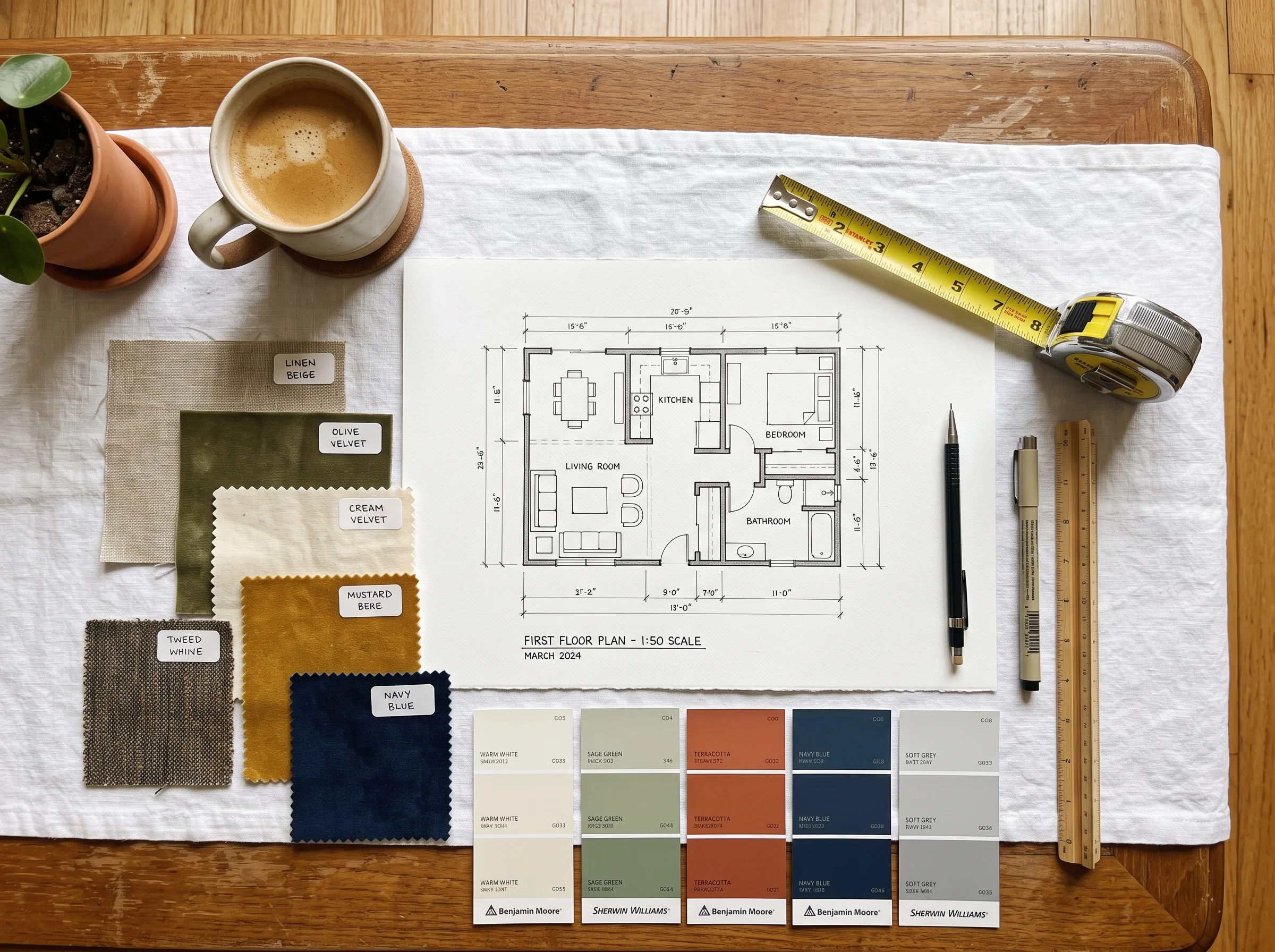
A well-planned room feels effortless. You walk in, everything is where it should be, the space flows, and you can't quite articulate why it works — it just does. That feeling isn't luck. It's the output of a deliberate methodology that professional designers apply, mostly invisibly, before a single piece of furniture is placed. The good news is that the methodology isn't a secret, and once you know the steps, you can apply them to your own room.
Here's the process designers actually follow to build a custom space plan, step by step, along with the rules that separate a room that works from one that feels off.
Step 1: Measure Accurately
Everything starts with a to-scale floor plan. Designers measure the room precisely — wall lengths, ceiling height, and the exact position of every fixed feature — and draw it to scale, typically on grid paper or in software. Guessing dimensions is the single most common cause of a plan that falls apart in reality: the sofa that "looked like it would fit" and doesn't. Accuracy here saves everything downstream.
Step 2: Identify Fixed Elements
Next, map what can't move: windows, doors and their swing paths, radiators, vents, electrical outlets, switches, and any built-ins. These constraints define the real playing field. An outlet's position dictates where a lamp can live; a door swing carves out space that furniture can't occupy. Designers mark all of it before placing anything, because these fixed points quietly govern every later decision.
Step 3: Define the Room's Function
Before arranging furniture, a designer nails down what the room is for — its primary function and its secondary uses. A living room might be primarily for conversation but secondarily for TV watching and occasional work. Those uses compete for space, and naming them upfront prevents a plan that serves one activity while sabotaging the others.
Step 4: Identify the Focal Point
Every well-designed room has a focal point — a fireplace, a large window with a view, a TV, or a statement piece of art. It's the anchor the eye lands on first, and crucially, everything else in the plan flows from it. Seating orients toward it. The layout organizes around it. Rooms that feel aimless usually have no clear focal point, or two competing ones fighting for attention.
"Find the focal point first. Once you know what the room is organized around, half the layout decisions make themselves."
Step 5: Map Traffic Flow
Now the designer traces how people move through the space — from doorway to seating, from entrance to exit, around the furniture. The working rules: main walkways need a minimum of 36 inches of clearance, and secondary paths can compress to about 18 inches. A plan that looks beautiful but forces people to squeeze between a sofa and a wall has failed at this step. Traffic flow is where comfort quietly lives or dies.
Step 6: Define Functional Zones
In larger or multi-use rooms, designers carve the space into zones — a conversation area, a reading nook, a work corner. Each zone gets defined by furniture placement and often anchored by a rug. Zoning is what lets one open room do several jobs without feeling chaotic. It gives each activity a clear home.
Step 7: Place Furniture Largest to Smallest
With the framework set, furniture goes in from biggest to smallest. The sofa or bed lands first, oriented to the focal point and respecting the traffic paths. Then the secondary seating, then tables, then lamps and accents. Working large-to-small prevents the classic error of filling a room with small pieces and then discovering the essential large one has nowhere to go.
Step 8: Check Scale and Proportion
Finally, the designer checks that everything is the right size relative to the room and to each other. Two rules do a lot of work here. First, a sofa should generally be no more than about two-thirds the width of the wall it sits against — bigger and it overwhelms, smaller and it looks lost. Second, a rug should be large enough to anchor all the major furniture in a grouping, ideally with the front legs of each piece resting on it. Scale mistakes are the most common reason a room full of nice things still feels wrong.
The Rules That Prevent Common Mistakes
Beyond the steps, a couple of hard rules catch the errors designers see most. Furniture shouldn't block windows — it kills natural light and makes a room feel smaller and stuffier. And in open spaces, never float furniture without a rug to anchor it; a seating group drifting in the middle of a bare floor reads as unfinished no matter how good the individual pieces are. These two rules alone fix a large share of amateur layouts.
The Quick-Reference Space Planning Checklist
| Step | Key Rule |
|---|---|
| Measure the room | Draw it to scale — no guessing |
| Map fixed elements | Windows, doors, outlets, vents |
| Define function | Name primary and secondary uses |
| Find the focal point | Everything orients toward it |
| Map traffic flow | 36" main paths, 18" secondary |
| Place furniture | Largest to smallest |
| Check scale | Sofa ≤ ⅔ wall width; rug anchors the grouping |
Where AI Fits Into This
The hardest part of space planning for most people isn't knowing the rules — it's picturing the result. You can measure the room and place the sofa on paper, but the leap from a top-down diagram to "how will this actually feel" is exactly where amateurs get stuck and where designers spend weeks in a rendering pipeline. AI closes that gap. You can test these arrangements in your actual room and see them rendered photorealistically before you push a single piece of furniture across the floor.
Try the sofa against two different walls. See whether that rug is really big enough to anchor the grouping. Check whether the layout leaves your walkways clear. Instead of committing to a plan and discovering the scale is off after everything's delivered, you validate the plan visually first — applying the same professional methodology, but seeing the outcome in seconds rather than imagining it or waiting weeks for a render.