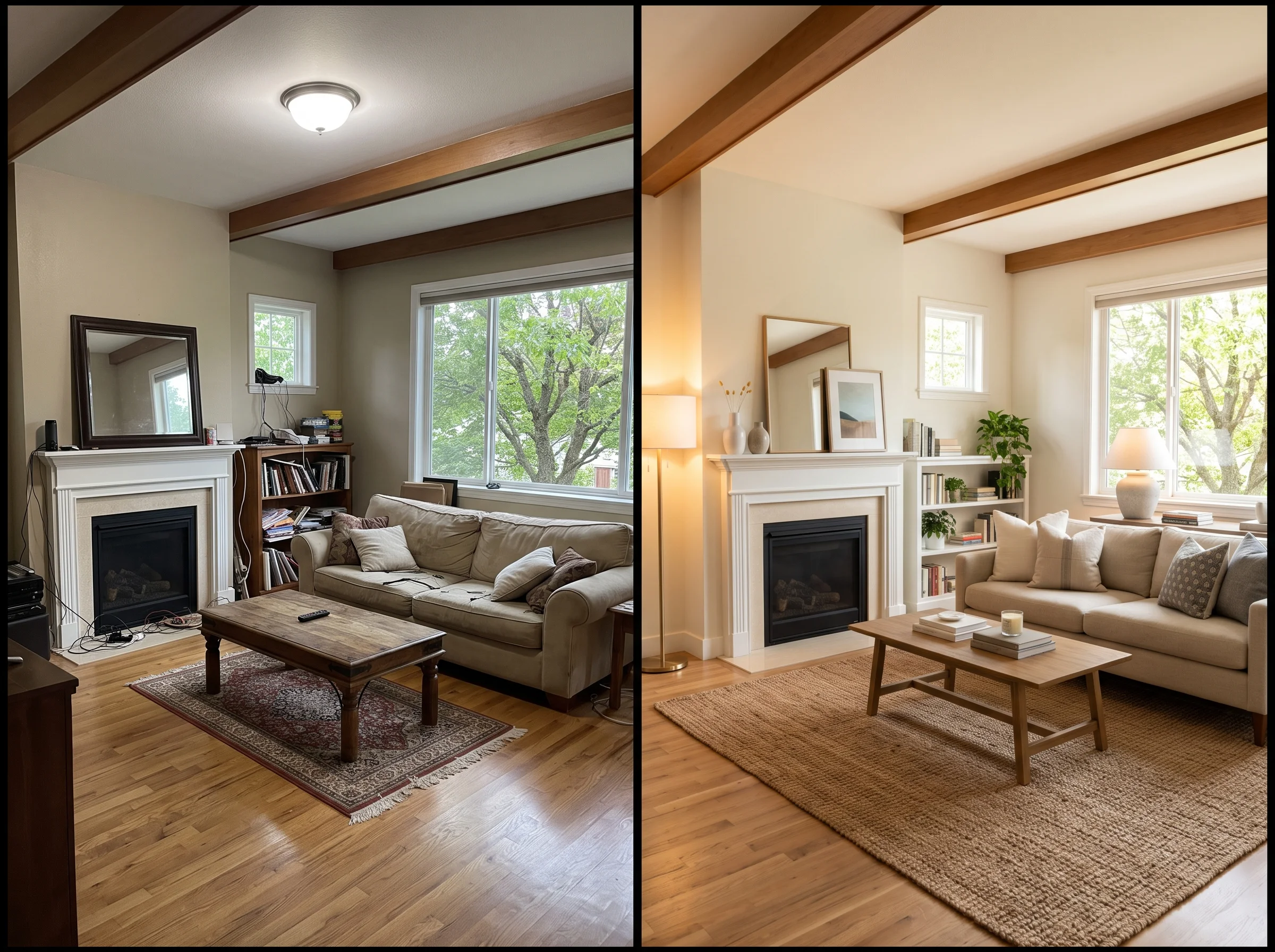
People assume good interior design is a function of money — that the difference between a magazine room and their own is the price of the furniture. It usually isn't. Plenty of expensive rooms feel mediocre, and plenty of modest ones feel genuinely good. The real dividing line is intention. Good design is a set of deliberate decisions, consistently applied; mediocre design is a set of individually reasonable choices that never got coordinated.
Here are the specific qualities that separate the two, so you can look at any room — including your own — and diagnose which side it's on.
The Qualities of Genuinely Good Design
1. Visual hierarchy. Good rooms have a clear focal point, and every other element supports it rather than competing with it. Your eye enters, lands somewhere on purpose, and then travels in an order the room has arranged for you. There's a lead and there's a supporting cast, and everyone knows their role.
2. Restraint. Good design uses fewer, better-chosen elements. Professional rooms often contain deliberate negative space — a bare stretch of wall, an empty corner — that an amateur would rush to fill. That restraint is what makes the pieces that are there feel selected rather than accumulated.
3. Texture contrast. Good rooms play textures against each other: smooth paired with rough, matte with shiny, soft with hard. A room that's all smooth and all matte reads flat; the contrast between a nubby wool throw and a polished table, a rough linen and a lacquered surface, is what gives a space depth you feel more than see.
4. Consistent intention. In a good room, every element reflects the same underlying aesthetic decision. Nothing was "snuck in" that doesn't belong — no lone piece fighting the direction of everything around it. The room reads as one idea, executed all the way through.
5. Functionality. Good design looks good and works for how people actually live. The seating supports conversation, there's a place to set a drink, the light falls where you need it. Beauty that fails the room's real job isn't good design; it's a stage set.
6. Obsessive attention to light. Professional designers specify every light source — ambient, task, accent — and think about warmth and height. Most homeowners never think about lighting at all beyond flipping the switch. This single difference does more to separate good from mediocre than almost anything else.
7. Appropriate scale. In good rooms, furniture is sized correctly for the space and for the other pieces. Nothing is marooned by being too small; nothing overwhelms by being too big. The proportions simply feel right, which is harder to achieve than it sounds and instantly noticeable when it's missing.
"Good design isn't expensive — it's intentional. Every element reflects the same decision, and nothing was snuck in that doesn't belong."
The Markers of Mediocre Design
Mediocre rooms tend to share a recognizable set of failures, and they're almost the exact inverse of the list above. Multiple competing focal points, so the eye has nowhere to settle. Furniture pushed flat against every wall, leaving a dead zone in the middle. A rug too small to anchor the seating. A single overhead light flattening everything. And objects that don't belong to the same aesthetic — a few things that wandered in from a different room's idea and never left.
None of these is about cost. Every one of them is a coordination failure: individually fine choices that were never made to agree with each other.
The One-Sentence Audit
Here's the fastest way to judge a room, including your own. Walk in and ask: what is this room about? A good room answers instantly — "it's a calm, warm reading room," "it's a bold, social entertaining space." A mediocre room can't be summarized because it isn't about anything; it's just a collection of furniture in a box. If you can't finish the sentence "this room is about ___" in a few words, the room lacks cohesion, and cohesion is the thing you're missing.
How to Move a Room From Mediocre to Good
The encouraging part is that every quality on the good list is a decision, not a purchase. You can add visual hierarchy by choosing a focal point and quieting everything else. You can add restraint by removing a third of the objects. You can add texture contrast, layer the lighting, and fix scale — all without buying a single expensive thing. Mediocre-to-good is almost always a matter of editing and rearranging, not spending.
The hard part is seeing the result before you commit. Rearranging real furniture to test a new focal point is exhausting, and you can't easily preview what layered lighting or a bigger rug would do. This is where visualizing your actual room first pays off: you can test a clearer hierarchy, more negative space, better scale, and warmer light on an image of your space, confirm the room now has a clear answer to "what is this about," and only then move the real furniture.
The Bottom Line
Good design and mediocre design don't separate at the price tag. They separate at intention — a clear focal point, real restraint, texture contrast, a single coherent aesthetic, genuine function, deliberate lighting, and correct scale. Every one of those is available to you regardless of budget, because every one is a choice. The rooms you admire aren't more expensive than yours. They're more decided.