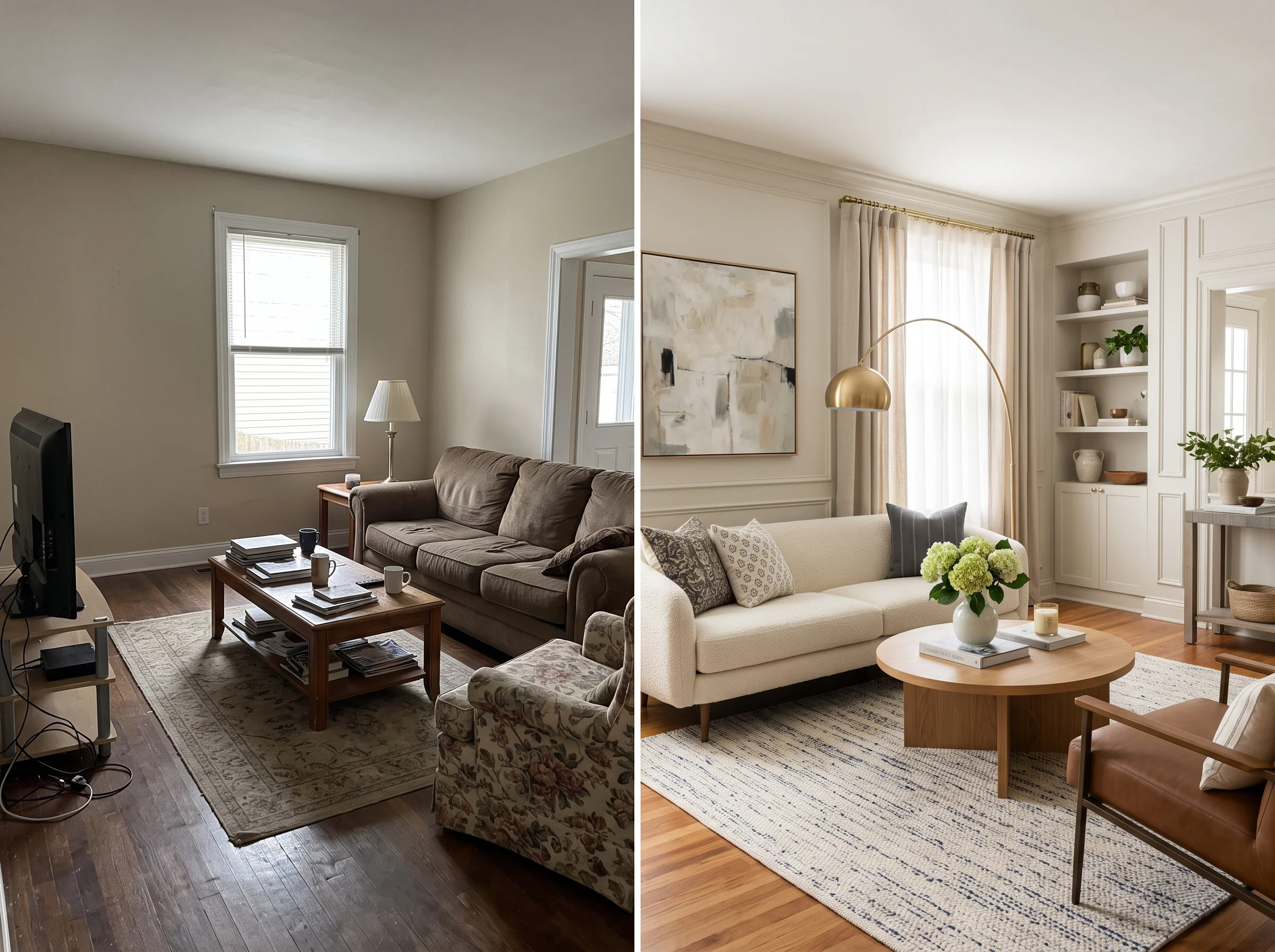
"Is an interior designer worth it?" is really a question about return on investment, and it deserves an honest answer rather than a sales pitch. A good designer can absolutely pay for themselves — but only on the right kind of project. On the wrong kind, you're paying premium rates for value you could get elsewhere for a fraction of the cost. Here's the real ROI case, and just as importantly, where it falls apart.
The Honest Case for a Designer's ROI
When people defend the cost of a designer, they usually gesture vaguely at "expertise." But the value is more concrete than that. It shows up in four measurable ways.
1. Mistake prevention. This is the most underrated line item. The average homeowner furnishing a room without guidance makes expensive wrong turns — a sofa that's too big, a rug that's too small, a color that reads completely different at home than in the store. Buying, returning, reselling, and rebuying your way to a room can easily waste $2,000 to $8,000 in furniture alone. A good designer prevents most of that by getting the decisions right the first time. For many projects, mistake prevention alone offsets a meaningful chunk of the fee.
2. Resale value. Design isn't only aesthetic — it's financial when you sell. Studies from the National Association of Realtors on staging consistently show staged and well-designed homes selling for somewhere in the range of 1 to 10 percent more than comparable un-staged ones. And design improvements concentrated in kitchens and bathrooms show the highest return of any room. On a home of real value, a percentage point or two dwarfs the designer's fee.
3. Contractor management. This is where a designer earns their keep on any renovation. Without professional oversight, renovation projects routinely run 20 to 40 percent over budget — through poor sequencing, miscommunication, change orders, and mistakes that have to be redone. A designer who manages the trades, catches problems early, and holds the schedule can save more than they cost on a project of any real size. The overrun they prevent is often larger than their entire fee.
4. Trade access. Designers get to-the-trade pricing, commonly 20 to 40 percent off retail on furniture and finishes, plus access to lines consumers can't buy. It's worth being honest here: their fees often offset much of this discount, so it's rarely free money. But on a large furnishing budget, the combination of better pricing and better products still adds real value.
"On a renovation, the budget overrun a good designer prevents is often larger than their entire fee. That's the ROI — not the taste, the oversight."
The ROI at a Glance
| Source of Value | Typical Impact |
|---|---|
| Mistake prevention | Saves $2,000–$8,000 in wrong purchases |
| Resale value | 1–10% higher sale price (NAR staging data) |
| Contractor management | Prevents 20–40% budget overruns |
| Trade access | 20–40% off products (fees often offset) |
Where the ROI Doesn't Hold
Now the part the industry is less eager to discuss. Every one of those four value sources depends on a project with real scope — furniture at scale, a home you're selling, a renovation with contractors, a large furnishing budget. Shrink the project and the ROI shrinks with it.
Consider the most common project of all: a single-room refresh with no structural work. New paint, a new layout, some furniture, updated decor. Here, three of the four value sources barely apply. There's no contractor to manage. There's no renovation budget to keep from overrunning. The trade discount on a modest furniture spend is small and partly eaten by the fee. What's left is mistake prevention and taste — and both of those come down to one thing: seeing the room clearly before you commit.
That's exactly the part AI now handles better and cheaper than anyone. When the entire job is visualization and style decisions, paying a designer's fee — and waiting weeks on their rendering pipeline — is paying premium rates for the one deliverable that's been commoditized. You can see your actual room in ten directions in an afternoon, avoid the expensive wrong purchases yourself, and never touch a five-figure engagement.
How to Tell Which Situation You're In
The deciding question isn't "can I afford a designer" — it's "does my project involve contractors or structural decisions?" If yes, the designer's ROI is real and often large; the oversight and coordination alone justify the fee, and you should hire one. If no — if the project is a refresh built on furniture, color, and layout — the ROI case thins out, and the visualization value you're really after is available for almost nothing.
A good designer is genuinely worth the investment. The mistake isn't hiring one; it's hiring one for the wrong project. Match the tool to the job: designers for the projects where their coordination and physical expertise pay for themselves, AI for the visualization and style decisions where it now delivers the return better than anyone. Do that, and you capture the ROI that actually exists instead of paying for the part that no longer requires a professional.