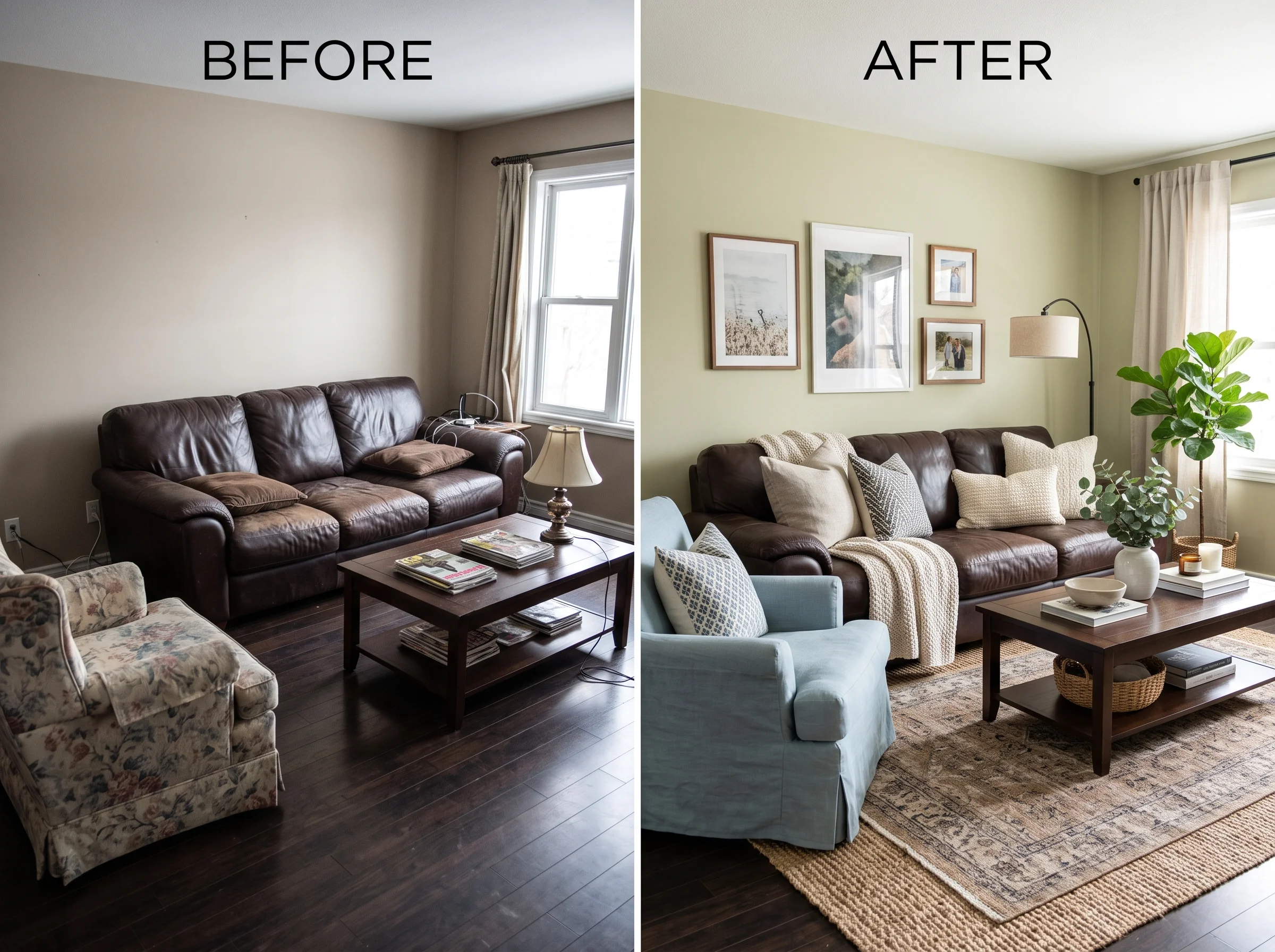
There's a myth that hiring a designer, or committing to a redesign, means gutting the room and starting over. Good designers don't work that way, and neither should you. They walk into a space full of your existing furniture and run a quick, disciplined assessment: what works, what can be refreshed cheaply, and what's genuinely fighting the room and has to go. Most of what you own usually stays. Here's the professional framework they use — one you can apply yourself.
The Four-Part Assessment for Every Piece
Designers evaluate each existing item against four questions, in roughly this order.
1. The scale test. Is this piece the right size for the space? This comes first because most "wrong" furniture is wrong in size, not style. A sofa that's too big crowds the room; a console that's too small looks lost. A piece you assumed was ugly is often just badly scaled for where it sits, and might be perfect in another spot or another room.
2. The quality check. Are the bones good, even if the surface is dated? A solid hardwood-frame sofa with tired upholstery is a keeper — the structure is what's expensive and hard to replace, and the fabric is cosmetic. A wobbly particle-board bookcase with a chipped veneer is not worth saving no matter how you dress it up. Judge the frame, not the finish.
3. The style compatibility test. Can this piece coexist with the new direction, or does it fight everything around it? Some pieces are flexible — a clean-lined wood table works across many aesthetics. Others carry so much specific character that they'll never blend with where you're going. The question isn't "do I like it," it's "can it belong here."
4. The function test. Does it actually serve the room's purpose? A gorgeous chair nobody can comfortably sit in, in a room built for lounging, is failing its job. Good design keeps pieces that earn their place functionally, not just visually.
"Most wrong furniture is the wrong size, not the wrong style. Before you replace a piece, check whether it just needs a different spot."
What Can Be Refreshed Cheaply
Here's where designers save clients real money. A huge share of "dated" furniture doesn't need replacing — it needs a small, targeted refresh. The most transformative options, roughly in order of impact per dollar:
Reupholstery. New fabric on a good frame is genuinely transformative and costs a fraction of a new sofa — typically $500 to $1,500 for a sofa depending on the fabric. If the frame is solid, this turns a tired piece into essentially a new one in your exact color.
Legs and hardware. Swapping out sofa legs, cabinet pulls, or drawer knobs for a new finish changes the whole character of a piece and often costs $100 or less. It's the cheapest high-leverage move in the whole toolkit.
Paint. Dressers, side tables, shelving units, and even some wood chairs can be completely reborn with paint. A dated brown dresser becomes a crisp modern piece for the cost of a can and an afternoon.
Repositioning. The cheapest refresh of all: moving a piece somewhere new. The same bookcase against a different wall, the same chair angled into a different corner, can transform how a room reads without spending anything. Never underestimate rearranging.
What Usually Has to Go
Designers are decisive about the small number of pieces that genuinely can't stay. Three categories tend to fail every time. Fundamentally wrong scale — a piece so oversized or undersized that no placement fixes it. Damaged structure — a frame that's failing, a joint that's loose, a case piece that's coming apart; cosmetics can't rescue bad bones. And style that simply cannot coexist — the rare piece so specific in its character that it will fight any direction you choose. Everything else is usually a candidate for keeping or refreshing.
The Hard Part: Deciding Before You Commit
The framework is clear, but the honest difficulty is that it's hard to see whether your existing sofa will work in the new direction until you've already committed to the paint, the rug, and the other new pieces. You're making keep-or-replace decisions on faith, and a wrong call is expensive in either direction — you either toss something that would have worked, or you build a room around something that ends up fighting it.
This is exactly where visualizing helps most. You can drop your existing pieces into the redesigned room — new wall color, new rug, new direction — and see whether your current sofa, table, or shelving actually belongs before you decide its fate. Test the reupholstered version, the repainted dresser, the repositioned bookcase. You get the designer's keep-refresh-replace judgment without having to physically move or buy anything first.
Work With What You Have
The professional approach to existing furniture isn't sentimental and it isn't wasteful. It's a quick assessment — scale, quality, compatibility, function — followed by cheap refreshes for most of what you own and honest replacement for the few pieces that truly can't stay. Done this way, a redesign costs a fraction of starting over and often looks better, because rooms built partly from pieces you already love have a depth that a showroom-in-a-box never quite achieves.