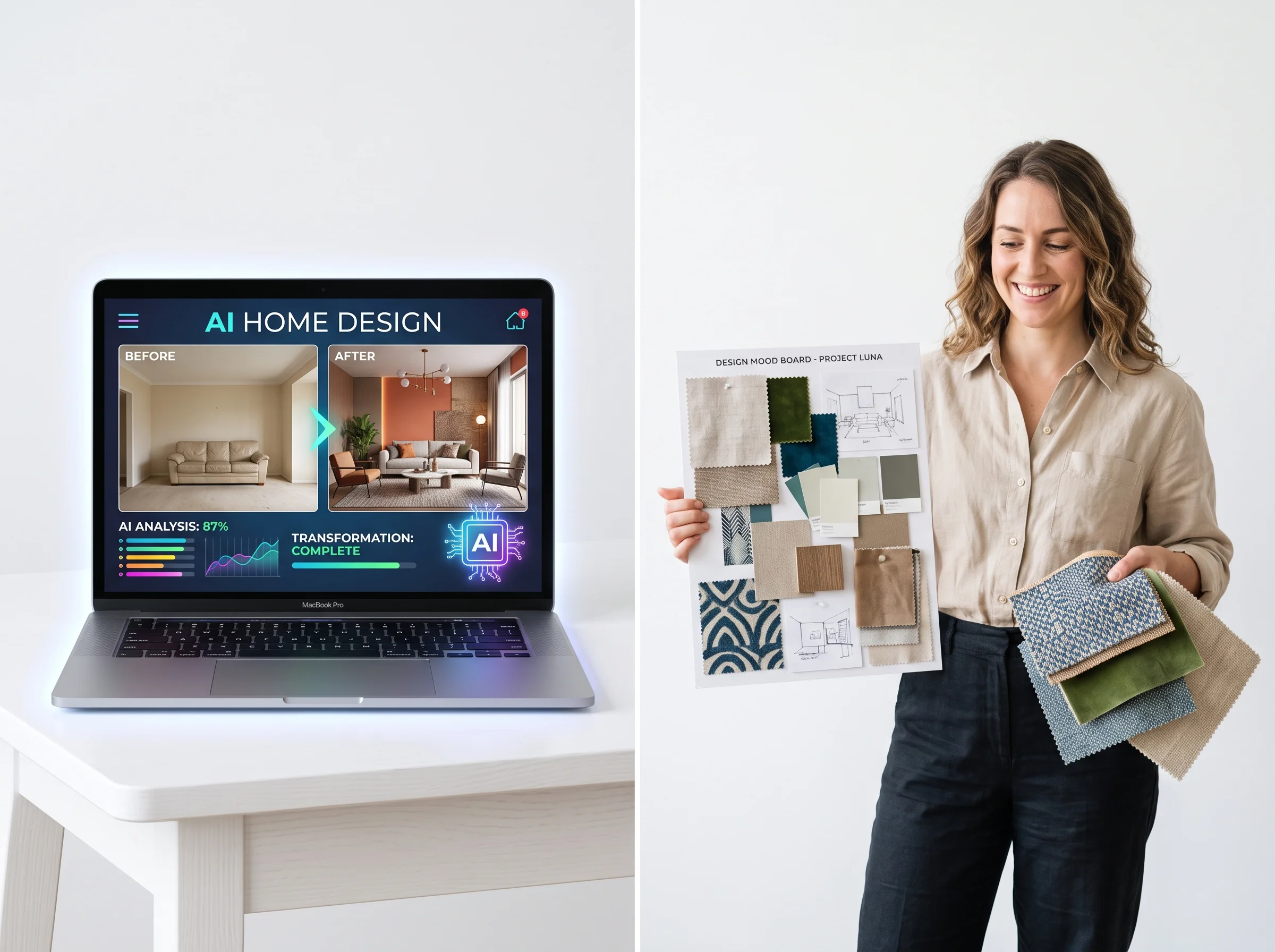
The honest answer to whether AI can design a room better than a professional is: it depends entirely on what you mean by "better." Better at what, exactly? Speed? Cost? The number of options you can explore? The durability of the fabric you end up buying? These are different questions with different answers, and anyone who gives you a blanket "yes" or "no" is selling something.
I've lived on both sides of this. I hired a professional designer for my own space, and I built an AI design tool after that experience frustrated me. So I'm not neutral — but I'm also not going to pretend AI wins across the board, because it doesn't. What follows is the breakdown I wish someone had given me before I spent money finding out.
Where AI Genuinely Wins
There are dimensions where AI isn't marginally better than a designer — it's better by an order of magnitude, and it's not close.
Speed. A designer's visualization loop runs in weeks. You brief them, they translate the brief, they queue it with a rendering studio, and the first image lands three to four weeks later. AI produces a photorealistic view of your actual room in about thirty seconds. When my designer needed a week just to describe my space verbally, the contrast became impossible to ignore.
Cost per iteration. A rendering studio charges $1,500 to $3,000 per room per revision round. An AI iteration costs cents. This isn't a small edge — it's the difference between exploring one direction and exploring twenty.
Number of options explored. Because iterations are nearly free and nearly instant, you can actually see your room in modern, traditional, minimalist, and maximalist directions in a single afternoon. A designer working through a rendering pipeline can realistically show you two or three before the budget and calendar say stop.
Visualizing furniture before you buy it. Considering a specific sofa? Drop it into a photo of your real room and see how it reads against your walls, your light, your floor. No designer can do this faster or cheaper than an AI tool can.
Getting agreement with a partner. Half of design disputes at home are really vocabulary disputes. "Cozy" and "clean" mean different things to different people. An image ends the argument. AI lets you put the actual picture on the table in seconds.
"AI doesn't have better taste than a designer. It gives you the freedom to exercise your own taste against twenty options instead of two."
Where a Designer Genuinely Wins
Now the other side, stated just as plainly. There are entire categories where AI can't compete and shouldn't pretend to.
Structural expertise. Moving a wall, opening a load-bearing partition, rerouting HVAC, adding a circuit — these are physical, regulated decisions. A designer stands in your space, reads your blueprints, and coordinates with engineers. AI cannot see behind your drywall or tell you whether your panel can take another load.
Tactile material knowledge. Will this fabric pill in six months? Will this wood dent under chair legs? Will this paint read warmer or cooler in your north-facing light at 4pm in January? Good designers know these answers because they've handled the materials for years. An image-generation model has no hands and no memory of how velvet wears.
Contractor coordination. On a real renovation, a designer is a project manager. They sequence trades, hold people to a schedule, mediate disputes, and absorb the operational chaos of a multi-month build. AI produces pictures; it doesn't call the plumber back.
Trade pricing access. Designers get to-the-trade pricing — often 20 to 40 percent off — and access to lines you'll never find on a consumer site. That relationship and that catalog are real value AI can't replicate.
Code and legal compliance. Permits, egress requirements, fire code, accessibility rules. A professional keeps your project legal and safe. This is not a place to trust a text-to-image model.
The Head-to-Head Comparison
Here's the breakdown side by side, so you can see exactly where each tool earns its keep.
| Dimension | AI Tool | Professional Designer |
|---|---|---|
| Speed to first visual | ~30 seconds | 3–4 weeks |
| Cost per iteration | Cents | $1,500–$3,000 |
| Options explored | Dozens | Two or three |
| Material durability judgment | No | Yes |
| Structural / load-bearing calls | No | Yes |
| Contractor management | No | Yes |
| Trade pricing access | No | Yes |
| Code / permit compliance | No | Yes |
The Question Behind the Question
When people ask "can AI design better than a designer," what they usually mean is "which one should I use for my project?" And that reframes the whole thing. You're not picking a winner in the abstract — you're matching a tool to a job.
If your job is visualization and exploration — seeing your room in different styles, testing a sofa before buying, aligning with your partner, arriving at a clear direction — AI wins, and it isn't close. This is the exact phase where a designer's outsourced rendering pipeline costs you the most time and money for the least differentiated value.
If your job is execution and physical expertise — moving walls, selecting materials by touch, managing a crew, keeping a permit-bound renovation on the rails — the designer wins, and AI shouldn't pretend otherwise.
The Honest Conclusion
Neither is universally better, because "better" isn't a single axis. AI beats a designer decisively on speed, cost, and the sheer number of options you can explore — the entire visualization and exploration layer of a project. A designer beats AI decisively on structure, materials, coordination, and compliance — the entire execution layer.
The smartest homeowners I know don't choose. They use AI to lock their direction in an afternoon, then bring in a designer only if the project crosses into structural or contractor territory. That sequence gets you the best of both: better decisions made faster and cheaper, executed by a professional when a professional is actually required. The question was never AI versus designer. It was which tool for which part of the job.