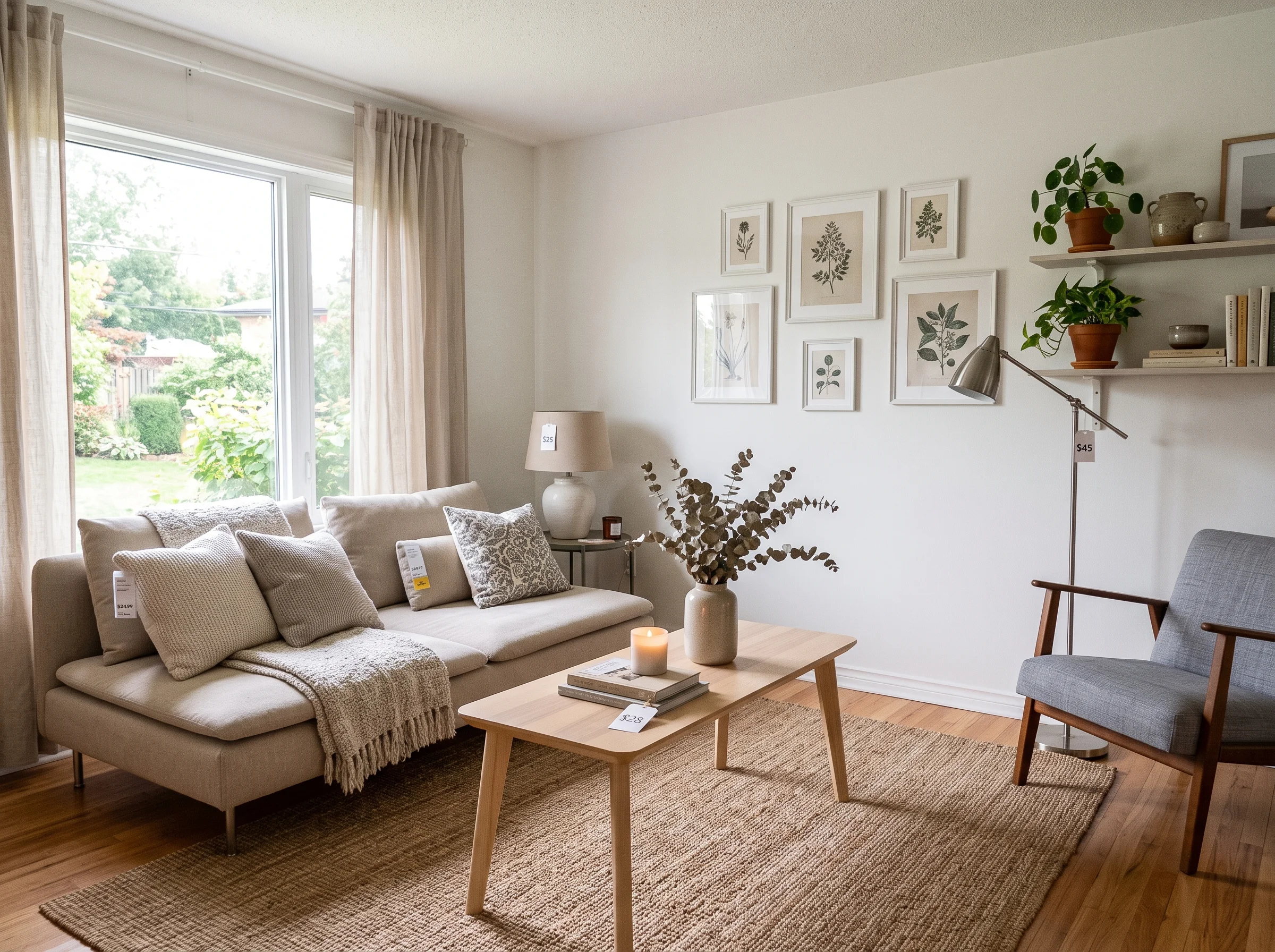
"Can I get interior design help for my budget?" is one of the most common questions homeowners ask, and the answer is almost always yes — but what "help" means changes dramatically depending on the number. The mistake most people make is assuming a small budget buys a watered-down version of the same thing a big budget buys. It doesn't. Each budget tier unlocks a fundamentally different kind of service. Here's the honest map.
Under $200: AI Tools
At this level, you're not buying a person's time — you're buying software that does the visualization. And that turns out to be a lot. For the cost of a subscription (or free credits to start), AI design tools let you upload a photo of your actual room and see it transformed photorealistically in seconds. Full style exploration, palette testing, furniture visualization, layout experiments — all of it.
What you don't get is a human's judgment on materials or a shopping list sourced through trade accounts. But for the core job of "help me see what my room could become and decide on a direction," this tier punches far above its price. It's where most single-room refreshes should honestly start.
$200 to $1,000: AI Plus a Consultation
Add a little budget and you can pair AI visualization with a one-off consultation — an hour or two with a designer, in person or virtual, to sanity-check your direction, flag mistakes, and answer specific questions. You do the exploration yourself with AI, then borrow a professional's eye briefly to validate it.
This is an underrated tier. A single paid hour with a good designer, armed with AI concepts you generated yourself, is far more productive than that same hour spent describing what you want in words. You've done the exploration; they add expertise at the margin.
"Budget doesn't determine the quality of your design decisions. Visualization quality does — and AI gives you professional-grade visualization at every budget level."
$1,000 to $3,000: An E-Design Package
Here you can buy a full e-design (virtual design) package. The designer works remotely: you send photos and measurements, they return a cohesive concept, a mood board, a to-scale layout, and a shopping list with specific products. You handle ordering and installation.
What you get is genuine professional direction and curation. What you don't get is contractor management or on-site presence. For a room that needs a considered plan and a real shopping list but no construction, this tier delivers a lot of value. Note that it still runs on a slower timeline than AI, because much of the concept work flows through the same visualization process professionals use.
$3,000 to $8,000: Limited Designer Hours
At this level you can afford a chunk of a full-service designer's time for a single room, or a partial-service arrangement. This starts to make sense when the room involves more than furnishings — some built-ins, a lighting plan, minor changes that benefit from a professional's coordination. You're buying real expertise and hands-on attention, but scoped tightly to keep it affordable.
$8,000 and Up: Full-Service Design
This is where full-service design becomes realistic, especially for kitchens, bathrooms, or projects with construction. You're paying for the complete package: concept, sourcing, contractor coordination, project management, and installation. For complex, structural, or whole-home work, this tier is where a designer's value is highest and hardest to substitute.
| Budget | What You Get |
|---|---|
| Under $200 | AI tools — full visualization and style exploration |
| $200–$1,000 | AI plus a one-off designer consultation |
| $1,000–$3,000 | E-design package — concept, layout, shopping list |
| $3,000–$8,000 | Limited designer hours or partial service |
| $8,000+ | Full-service design and project management |
The Insight That Reframes the Whole Question
Here's the thing most budget guides miss. People assume a bigger budget buys better design decisions — that the $10,000 room is smarter than the $500 room. But budget doesn't determine the quality of the design thinking. What actually drives good decisions is visualization quality: the ability to see options clearly before committing. And AI now delivers professional-grade visualization regardless of your budget.
When I hired a designer for my own space, the expensive part wasn't the idea — it was the weeks and dollars it took to see the idea rendered. Now that seeing is nearly free, the design-decision layer is effectively democratized. A person with $200 and a person with $20,000 can both see their room in ten styles and choose confidently. The insight — the taste, the direction — is available to everyone.
Where Budget Actually Matters
So what does more money actually buy? Two things: the quality of the physical products you install, and the quality of the execution. A larger budget buys a better sofa, solid-wood over veneer, hand-glazed tile over builder-grade, and a skilled crew to install it all correctly and on schedule. That's real, and it's where the money genuinely shows.
But the decision of which direction to go — that no longer scales with budget. So the smart play at any budget is the same: use AI to nail the visualization and the direction for almost nothing, then spend whatever budget you do have on the products and execution that actually benefit from it. Don't burn your budget paying professional rates to explore options you could explore yourself in an afternoon.