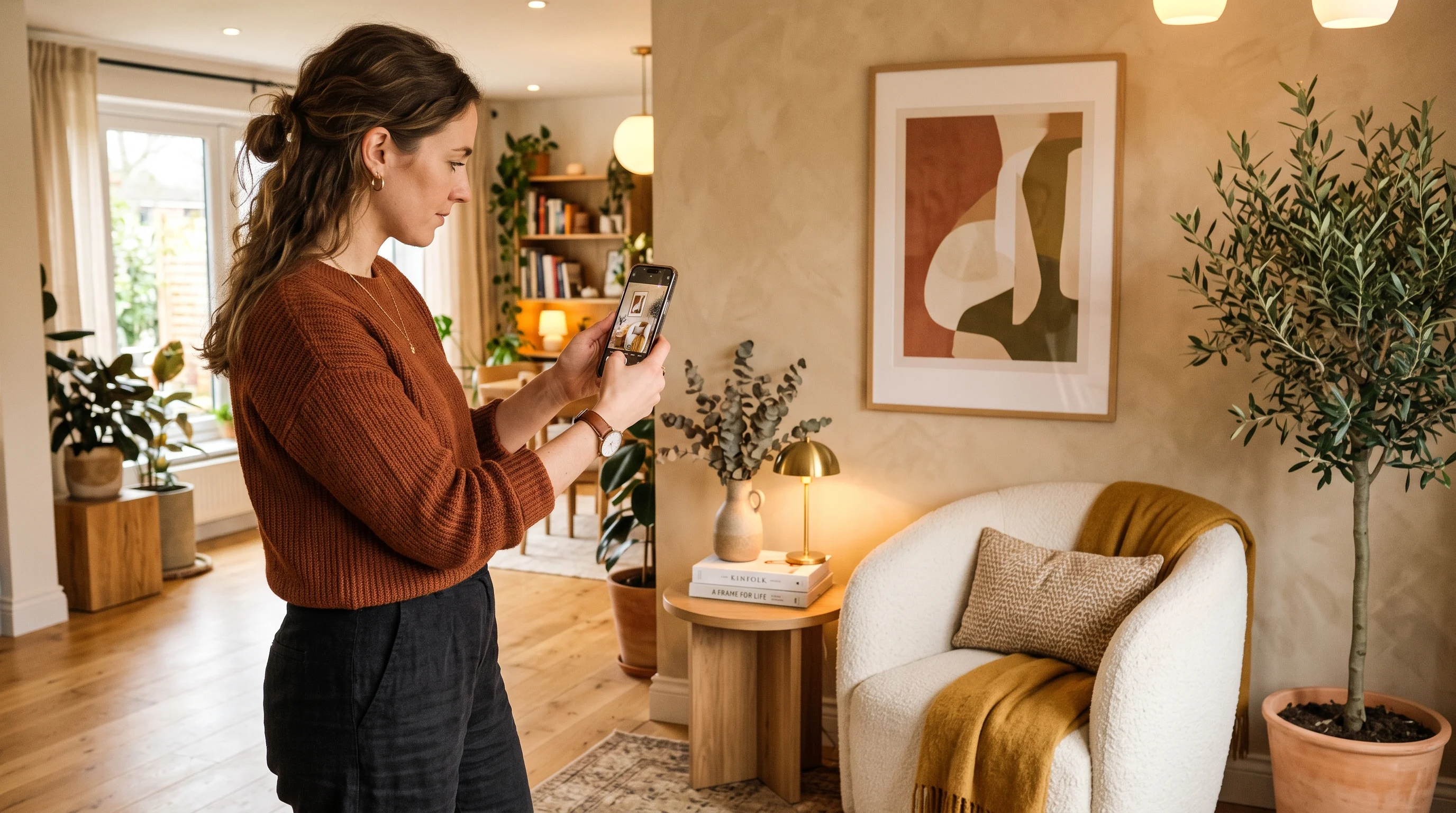
Interior design is one of the most visual professions there is, which makes social media a near-perfect fit — and yet most designers use it badly. They post a finished project every few weeks, get a handful of likes from friends and family, and conclude that social does not work for their business. The problem is not the platform. It is that a portfolio dump is not a marketing strategy. Instagram rewards designers who show up consistently, teach as much as they sell, and understand that the goal is not followers — it is a pipeline of people who trust you enough to hire you.
This is the social-specific playbook: how to choose the right platforms, what to actually post so it converts, how before-and-after content becomes your unfair advantage, how often to post without burning out, and — the part most designers skip — how to turn passive followers into paying clients. If you want the broader acquisition strategy beyond social, pair this with our guide to getting interior design clients. Here, we go deep on the feed.
Why Social Matters for Designers
Social media matters for designers for a reason that goes beyond reach: it is where your work can be seen at scale, and design is a business of being seen. A prospective client scrolling Instagram is already in a receptive, visually-oriented mindset. When they encounter a designer whose work stops their thumb and whose feed makes them feel understood, that is worth more than any directory listing or business card.
It also does the trust-building work that used to require a referral. A well-run account lets a stranger watch you think, see your range, and understand your taste before they ever contact you — so that by the time they reach out, they are pre-sold. In a field where clients are choosing someone to trust with their home and a significant budget, that accumulated familiarity is the whole game. Social is not a vanity project for designers; it is the top of the funnel.
Choosing the Right Platforms
You do not need to be everywhere. For interior designers, the platforms rank clearly by value, and spreading yourself thin across all of them is a common mistake.
- Instagram is the primary platform — visual-first, strong for both feed portfolio and Reels reach, and where design clients actively look. If you do one thing well, do this.
- Pinterest is underrated and functions more like a search engine than a social feed. Design content has an exceptionally long life there, driving traffic for months or years after posting. A strong complement to Instagram, especially for the discovery phase.
- TikTok offers the largest organic reach right now and rewards personality and process content. Worth it if you are comfortable on camera and can post consistently.
- LinkedIn matters mainly for commercial, trade, and B2B design work — connecting with developers, architects, and builders rather than homeowners.
Pick one primary platform (almost always Instagram), master it, and repurpose that content to a secondary platform (Pinterest or TikTok). One excellent account beats four neglected ones every time.
Content Pillars That Convert
The reason most design accounts stall is that every post is the same thing: "here is a finished room." An audience needs variety to stay engaged, and a business needs its content to do more than display. Build your feed on four content pillars and rotate through them.
- Transformations. Before-and-after content — the single highest-performing category for designers. The visible change is inherently satisfying and shareable.
- Education. Teach something: how to choose a rug size, why a room feels cold, the mistake people make with lighting. Educational content positions you as the expert and gets saved and shared.
- Process and behind-the-scenes. How you work, how a concept evolves, a source walk-through. This builds trust and connection — people hire people they feel they know.
- Personality and point of view. Your opinions, your taste, your story. This is what differentiates you from every other competent designer and makes an audience loyal to you.
The mix matters: heavy on transformations and education (which pull people in), seasoned with process and personality (which build the relationship). An account that is only finished-room photos gives an audience no reason to follow, engage, or trust.
"Followers don't hire you. Trust hires you. Every post should either prove you're good or prove you're worth knowing — ideally both."
Before/After Posts and Reels That Perform
Before-and-after is the designer's superpower on social, because the transformation does the persuading for you. The dramatic reveal is one of the most reliably engaging formats on any platform — the eye cannot help but compare. In Reels, the before-to-after transition, timed to a beat, is close to a guaranteed performer.
The obstacle has always been supply. You only have as many before-and-afters as you have completed projects, and finished projects come slowly. This is where the content bottleneck breaks. Instead of waiting months for a project to finish and be photographed, you can generate compelling before-and-after visuals from any room photo in minutes — reimagining a real space in a striking new direction and showing the transformation. That means you can post transformation content on a consistent schedule rather than whenever a project happens to wrap. Generate scroll-stopping before-and-after visuals with Decorb to keep your highest-performing content category always stocked. Our guide to the fast render alternative covers the workflow in depth.
Posting Cadence and Consistency
Consistency beats frequency, and both beat perfection. The algorithm and your audience both reward showing up on a predictable rhythm far more than they reward sporadic bursts of brilliance. A realistic, sustainable cadence for a working designer is three to five feed or Reel posts per week, plus regular Stories to stay present between posts.
The mistake that kills most design accounts is the burnout cycle: a designer posts daily for two weeks, exhausts their ideas and energy, then goes silent for a month. That inconsistency signals to the algorithm that you are inactive and to your audience that you are unreliable. It is far better to commit to three genuinely good posts a week, every week, indefinitely, than to sprint and stall. Pick a cadence you can maintain during your busiest project weeks, and hold it.
Turning Followers Into Paying Clients
An audience that never converts is a hobby, not marketing. The bridge from follower to client is deliberate, and most designers never build it. A few essentials:
- Make your offer obvious. Your bio should say exactly what you do, who you serve, and how to start. A clear call to action and a booking or inquiry link removes friction.
- Include calls to action in content. Invite people to DM you, book a consultation, or visit your site. People follow instructions when you give them.
- Use Stories to sell softly. Behind-the-scenes, client wins, availability updates, and consultation openings live well in Stories, where a warm audience is watching.
- Move interested people off-platform. A follower who DMs is a lead — respond fast, then move them to a proper consultation or your onboarding flow. Once they are ready, a photorealistic concept of their actual room closes the gap between interest and commitment.
The goal of the whole system is to convert attention into conversation and conversation into contract. Content earns the trust; the call to action and a fast, visual pitch convert it. For the closing side of this, our guide to winning clients with AI presentations is the natural next read.
Batching Content Without Burning Out
The reason consistent posting feels impossible is that most designers create content one post at a time, in the gaps of a busy schedule — which means it constantly loses to client work. The professional solution is batching: setting aside one focused block, once or twice a month, to produce a large batch of content at once, then scheduling it out.
A practical batch session: generate a set of before-and-after visuals, write captions for two weeks of posts, film a handful of short process or talking-head clips back to back, and load everything into a scheduler. When your content for the next two weeks is already made and queued, posting consistently stops depending on daily willpower or a free hour that never comes. The designers who post reliably are almost never posting daily in real time — they batched it, and the calendar runs itself. Combine batching with fast visual generation and a sustainable cadence, and social becomes a steady lead source instead of a recurring source of guilt.
Captions, Hashtags, and Getting Found
The visual stops the scroll, but the caption often does the converting. Treat your captions as short pieces of writing, not afterthoughts. The reliable structure is a strong first line (the part that shows before "more" is tapped), a middle that teaches or tells a story, and a clear call to action at the end. A transformation post whose caption explains why the room did not work before and what the specific changes accomplished does far more for your credibility than one captioned "swipe to see the after." You are proving you think like a designer, not just that you can decorate.
Discovery still depends partly on the mechanics. Use a focused set of hashtags that mix broad design tags with specific niche and local ones — the local tags in particular are how nearby clients find you. Write keyword-aware captions and alt text, because Instagram and Pinterest increasingly surface content through search rather than only the follow graph. Geotag your posts. Engage genuinely with accounts in your niche and your area, since the relationships you build in comments and DMs feed the algorithm and, more importantly, feed your referral network. None of this is glamorous, but it is the difference between content that only your existing followers see and content that reaches the strangers who become clients.
It is also worth setting honest expectations about the timeline. Social media is a compounding asset, not a slot machine — the account that looks like an overnight success almost always spent six to twelve quiet months building the foundation first. For the first stretch, you are posting largely to a small audience and it can feel like shouting into a void. Push through it. The follower count is the least important metric; what matters is that each week your body of work grows, your point of view sharpens, and the trust bank fills. The leads and referrals tend to arrive in a lump once that groundwork is laid, which is exactly why the designers who quit at month three never see the results and the ones who hold the cadence eventually wonder how they ever found clients any other way.
Instagram works for interior designers who treat it as a system rather than a scrapbook. Choose your platform, build on four content pillars, lean into transformations, post on a rhythm you can sustain, batch to stay ahead, and always build the bridge from follower to client. Do that consistently and social stops being the thing you feel bad about neglecting and becomes the thing that quietly fills your calendar. Keep building with our guides to building a portfolio with AI concepts and the complete AI toolkit for designers.